.svg)
From generative tools in 2024 to autonomous agents in 2026: Explore how the rapid AI sprint is reshaping global infrastructure, governance, and the modern workforce.
If you feel like you’ve just lived through a decade of technological change in the last two years, you aren’t imagining it. In the jungle of tech, 2024 was the year we were all just learning how to use our thumbs. We were impressed by AI that could write a poem or summarize a meeting.
Fast forward to today, and the landscape is unrecognizable. We’ve moved from tools that talk to agents that act. Let’s look at just how far we’ve swung in just 24 short months.
In 2024, generative AI was the star of the show. We used it as a high-speed drafting machine. Back then, only about 33% of businesses had adopted generative AI, primarily for creative tasks like website copy or brainstorming. It was a productivity multiplier, but it still required you to hold its hand through every single turn.
By 2026, that number has skyrocketed to 77% of businesses using AI in at least one function. But the real shift isn't just in how many people are using it; it’s in what it’s doing. We’ve entered the era of Agentic AI. While 2024 AI could draft a shipping update, 2026 AI identifies the order, tracks the data, updates the CRM, and issues a refund autonomously.
As the World Economic Forum notes, the agentic AI market is poised to hit $45 billion by 2030, but the foundation was laid right here in 2026.
The scale of investment between then and now is staggering. In 2024, we were worried about whether we had enough chips to keep up with the hype. By 2026, the challenge has shifted to the literal power grid.
Hyperscalers have poured more than $400 billion into capital expenditure in 2025 alone, with that figure set to jump another 75% this year. To put that in perspective, data center energy consumption is expected to approach 1,050 Terawatt hours by the end of 2026. If data centers were a country, they would now be the fifth-largest energy consumer on Earth—sitting right between Japan and Russia. We aren't just building software anymore; we’re rebuilding global infrastructure.
Two years ago, the legal landscape was the Wild West. We were having theoretical debates about copyright and fair use. In 2026, the accountability era has arrived.
The EU AI Act is now in its phased implementation, and in the U.S., we’re navigating a complex patchwork of state laws. From the Texas Responsible AI Governance Act (TRAIGA) to Colorado's new standards, businesses can no longer just deploy and hope for the best. We’ve moved from "Can we do this?" to "How do we govern this?" Courts are now actively scrutinizing agentic liability—asking who is responsible when an autonomous agent signs a bad contract.
In 2024, the primary narrative was one of replacement. Everyone was worried the bots were coming for their desks. Today, the sentiment has matured. Our 2026 SalesApe survey found that while 59.3% of sales pros still have concerns about redundancy, 40.7% now see AI as a career upgrade rather than a threat.
We’ve realized that AI isn't a replacement for the human expert; it’s the ultimate teammate. In 2024, we were spending hours on data entry. In 2026, 32.4% of workers are reclaiming 3 to 5 hours every week through automation. We're no longer fighting the tools—we're using them to climb higher.
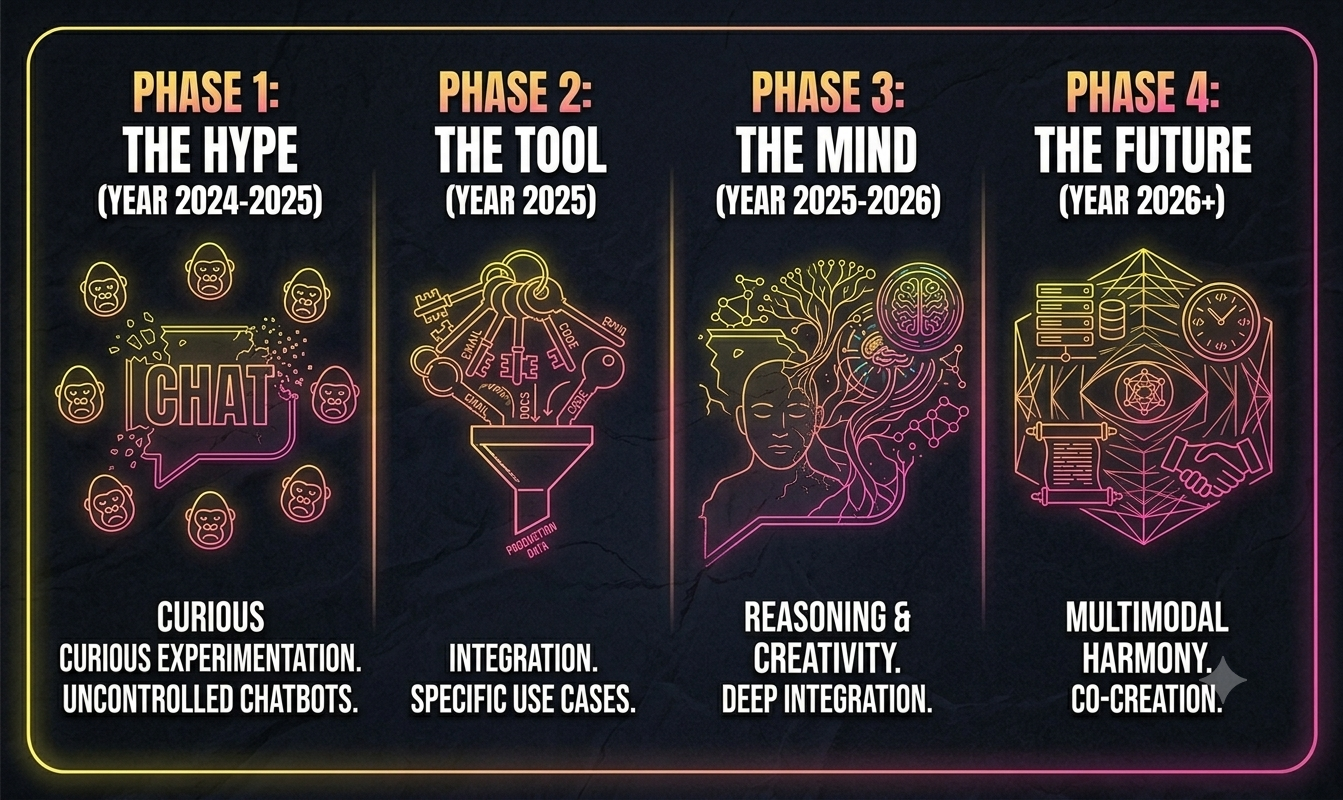
In 2024, models lacked the "long-horizon planning" needed to execute complex tasks without failing. By 2026, improvements in multi-step reasoning and model reliability made it operationally viable for AI to act as an agent rather than just a chatbot.
A single AI query today uses nearly 10 times the electricity of a conventional search. This has led to a 160% projected increase in power demand through 2030, forcing tech giants to invest heavily in new energy sources like Small Modular Reactors (SMRs).
Without a single federal AI law, states like California and Texas have created their own rules. This means if you operate across state lines, you need to build your AI compliance program around the strictest available standards to avoid heavy fines and litigation.
While some roles are being disrupted, the focus has shifted to upskilling. 45.9% of professionals now believe that "AI Management" will be a core job requirement by 2027. The most successful workers in 2026 are those who have learned to manage their AI assistants rather than compete with them.
Don't let your sales strategy stay stuck in 2024. The transition from talking to acting is the competitive advantage of the decade.
Book a Demo today to see how a SalesApe agent can transform your inbound funnel, or email us at hello@salesape.ai to start your evolution.