.svg)
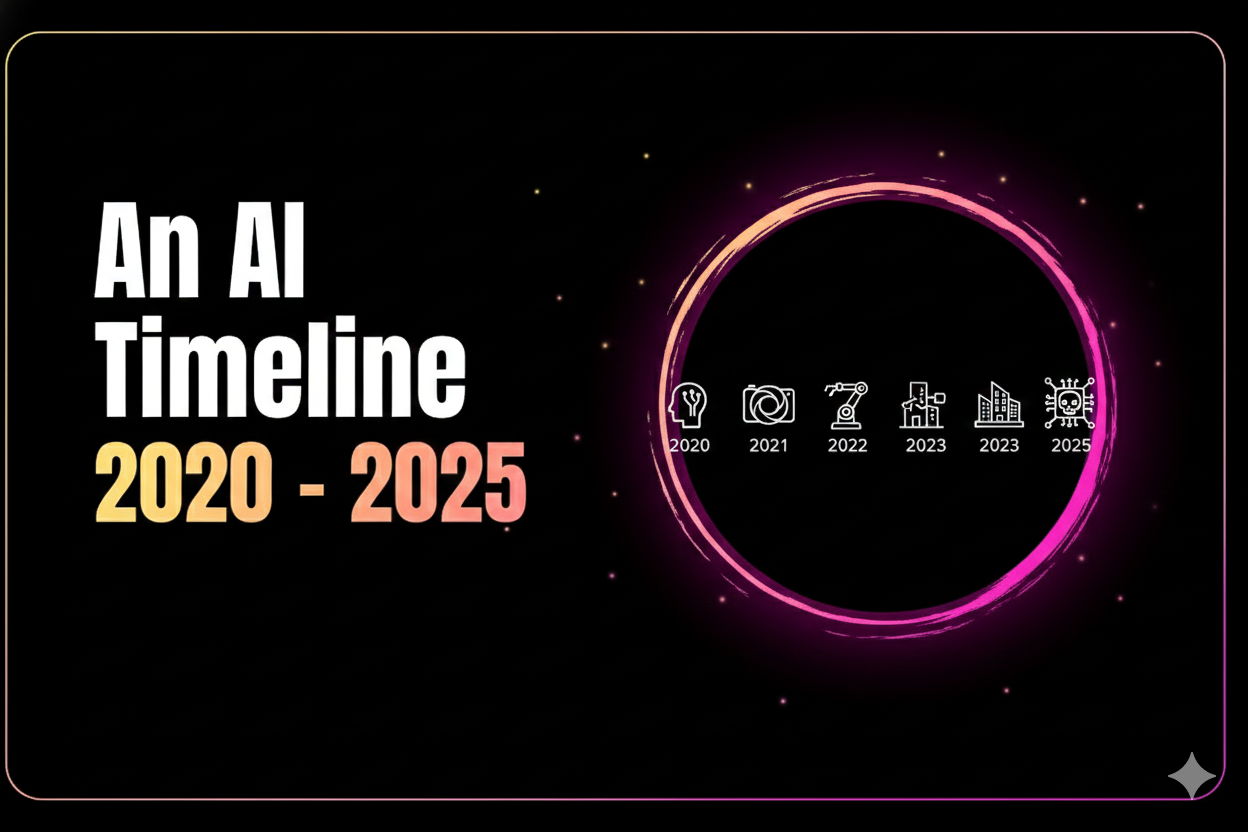
Explore the rapid, exponential evolution of AI from 2020 to 2026. See key milestones like GPT-3, ChatGPT, and AlphaFold, and learn how AI has transformed global business.
If you're still debating if AI is a passing trend, this timeline should change your mind. In just five years, Artificial Intelligence has moved from solving theoretical scientific puzzles to actively generating revenue for companies of all sizes around the globe. For business leaders, this isn't ancient history—it's the story of how quickly the market changed around you.
2026 Editorial Update: We have expanded our original historical timeline to include the pivotal market data, regulatory shifts, and structural developments that defined the commercial landscape over the past year. This update ensures our resource library reflects the current state of enterprise automation.
Trained on your business, handling real customer conversations — not a demo of what AI could theoretically do.
This year marks the end of the AI Stone Age and the beginning of exponential growth. The technology proved it could solve problems previously reserved for the world's most brilliant human minds.
AI stepped out of the lab and into the creative suite, showing it could augment human workers beyond data entry and analysis.
This was the watershed year when AI left the developer community and went public, changing the definition of a "conversational system" forever.
The conversations about AI shifted from "if" to "when," as tangible, quantifiable data proved the technology was delivering major returns.
Trained on your business, handling real customer conversations — not a demo of what AI could theoretically do.
AI became firmly embedded across core business functions, and the technology advanced to the next level of autonomy.
This year, AI achieved comprehensive global and physical integration, demanding a full commitment to governance and upskilling.
This timeline shows that AI innovation doesn't follow a linear path; it's exponential. The change we've seen in the last five years is just the warm-up. The last five years have seen AI evolve from a specialized tool to a ubiquitous, transformative technology integrated across numerous aspects of daily life and industry, driving unprecedented changes in capabilities and regulation.
The primary difference lies in the level of human oversight required for task execution. The early generative tools introduced between 2020 and 2023 functioned strictly as assistive co-pilots, meaning they required continuous human prompts, revisions, and step-by-step guidance to complete a single task. The agentic architecture dominating the market today possesses structural reasoning, contextual memory, and delegated authority. These modern systems can independently plan, use external software tools, and execute highly complex, multi-step business processes from start to finish without requiring constant human intervention.
While international frameworks like the European Union's AI Act established rigid, centralized legal boundaries, the approach within the United States has focused heavily on sector-specific governance and consumer protection compliance. Federal bodies, including the Federal Trade Commission (FTC) and the Securities and Exchange Commission (SEC), have drastically increased oversight regarding algorithmic transparency, data privacy, and deceptive marketing. For businesses operating today, maintaining compliance means ensuring that any automated system touching consumer data operates with a clear, auditable trail that respects established state-level privacy mandates and federal fair-practice guidelines.
The current performance divide stems almost entirely from organizational friction and legacy operating models. Many companies fell into the trap of installing powerful, automated systems directly on top of outdated corporate workflows without altering their underlying structure. High-performing organizations achieve substantial returns because they treat automation as an architectural redesign. Instead of using technology to simply speed up old processes, they rewrite their internal playbooks entirely, using autonomous agents to absorb routine administrative bottlenecks so their human capital can dedicate undivided attention to complex relationship-building and strategic expansion.
The foundation was laid in 2020 with the launch of OpenAI's GPT-3 language model, which was the first to generate truly human-like text at scale. However, the Generative AI boom entered the mainstream public consciousness in 2022 with the public launch and widespread adoption of ChatGPT.
The adoption accelerated significantly. In 2020, roughly 20% of global businesses began adopting AI. By 2024, this had increased to a staggering 78% of organizations reporting that they were using AI in at least one business function. AI officially became a non-negotiable tool for operational efficiency in 2024.
The year 2020 marked the end of the "AI Stone Age" and the beginning of exponential growth. This was when Google DeepMind's AlphaFold solved protein folding, proving AI could solve a major scientific challenge previously reserved for the world's most brilliant human minds. The technology's value in high-stakes clinical settings was further proven in 2021 as AI-driven diagnostics began transforming patient care.
The Era of Autonomy signifies that AI has achieved comprehensive global and physical integration. This is evidenced by an estimated 50% of global industries relying on AI, the emergence of AI agents performing complex tasks like autonomous purchases online, and the development of physical intelligence through significant updates to humanoid robots.
Yes, as AI's power became widespread, the focus shifted to ethical AI and regulation in 2025. The European Union's AI Act moved toward full implementation, setting a global standard for ethical AI and accountability.
Trained on your business, handling real customer conversations — not a demo of what AI could theoretically do.