.svg)

Move beyond prediction. Prescriptive Analytics uses AI and optimization to prescribe the single, revenue-generating action to take. Master the final stage of business intelligence.
We’ve all heard the phrase; come to me with solutions not problems - Prescriptive Analytics actioned this!
In the world of sales and marketing data, we’ve spent years getting comfortable with Predictive Analytics. We grew accustomed to tools that told us a lead had a 70% chance of closing or that a customer was likely to churn. But as powerful as that foresight is, it often leaves managers with a difficult follow-up question: "Now what?"
This is where Prescriptive Analytics comes in.
If predictive analytics is the weather forecast that tells you it’s going to rain, prescriptive analytics is the GPS that automatically reroutes your car to avoid the storm and tells you exactly which umbrella to grab.
It is the final and most powerful stage of business intelligence, moving beyond prediction to direct action.
To understand where prescriptive analytics fits, it helps to look at the four stages of data maturity:
Prescriptive analytics uses a combination of Machine Learning, Business Rules, and Mathematical Optimization to recommend specific actions. It doesn't just show you a problem; it hands you the solution.
For a business, prescriptive tools are becoming the "brains" behind the most successful sales and operations teams.
Airlines and hotels have used basic versions of this for years, but it has now reached the B2B world. Prescriptive models analyze market demand, competitor stock levels, and a prospect's historical behavior to tell a sales rep: "Offer a 12% discount if they sign by Friday, but stay firm on the implementation fee."
Instead of a marketing manager guessing which whitepaper to send, a prescriptive engine analyzes the prospect's Digital Body Language and prescribes the exact asset. According to research from Gartner, organizations using Next Best Action logic see a significant lift in conversion rates because the guesswork is removed from the sales rep's daily routine (Source: Gartner: Core Capabilities of Sales Enablement).
In industries like retail or manufacturing, prescriptive analytics handles the What-If scenarios of a global economy. If a shipping port is delayed, the AI doesn't just flag the delay; it prescribes a specific alternate route and calculates the exact cost-benefit of switching suppliers in real-time.
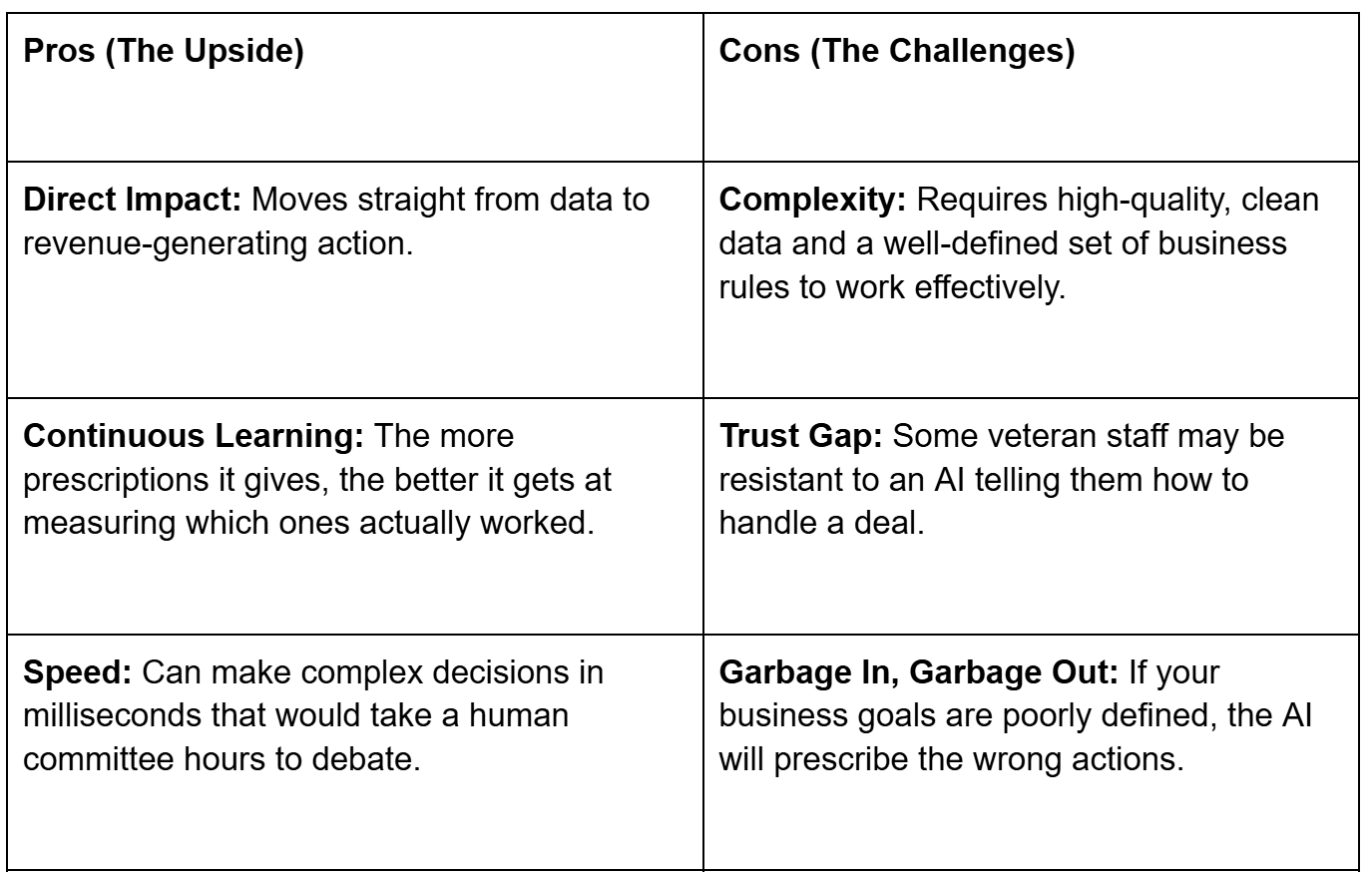
The shift to prescriptive analytics isn't just a technical upgrade; it’s an economic one.
Not quite. Automation is a "Do this every time" rule (e.g., If a lead signs up, send an email). Prescriptive Analytics is a "Do this because of these variables" recommendation. Automation is about effort, while prescriptive analytics is about strategy.
The best prescriptive models are designed for Human-in-the-Loop decision-making. The AI provides the Prescription and the Reasoning, but the human professional makes the final call. Think of it like a doctor: the AI runs the diagnostic tests and suggests the treatment, but the doctor is the one who talks to the patient and administers the care.
You need more than just Historical Data. To get a prescription, the AI needs to know your Constraints (e.g., What is your minimum margin?) and your Objectives (e.g., Is your goal current profit or long-term market share?). Without these boundaries, the AI doesn't know what good looks like.