What You Need To Know About The AI Safety Report 2026
Kim Taylor
•
March 18, 2026
•
8 mins
The AI Safety Report 2026 reveals critical AI risks for US business, from escalating cyber threats to job market shifts. Learn what American leaders must know about defense and governance.
For decades, the conversation around Artificial General Intelligence (AGI) and advanced AI was confined to science fiction novels and academic labs. But as AI systems rapidly evolve from simple tools to complex problem-solvers, the potential for both revolutionary benefit and profound risk has become a global concern.
The International AI Safety Report 2026, published by the UK government, represents the first comprehensive, scientific assessment of these capabilities and dangers. While it’s an international effort, its findings are not just relevant—they are critically important for every US business leader, policymaker, and informed citizen. This report is the definitive state of the union for advanced AI, detailing why the risks are escalating and what steps are needed to secure our digital future.
TL;DR
US at the Epicenter: The US is leading AI development, producing 64.5% of major AI models, making this report's findings directly impactful on national innovation and risk.
Economic Transformation: AI is set to reshape the US job market, with 60% of advanced economy jobs exposed to AI, impacting both entry-level and expert roles.
Escalating Cyber Threats: AI enhances cyberattack capabilities by identifying software vulnerabilities and generating convincing deepfakes for scams, directly threatening US infrastructure and citizens.
Regulation on the Horizon: The report provides a technical foundation for US regulatory bodies like NIST and state legislatures (e.g., California's SB 942) as they grapple with how to govern AI effectively.
Why The AI Safety Report Demands US Attention
The International AI Safety Report isn't just a foreign policy brief; it's a direct dispatch from the front lines of global AI development, with the US prominently featured.
The US is a Global AI Powerhouse
The report underscores that the United States is the undisputed leader in AI innovation. Of all notable AI models developed globally in 2024, a staggering 64.5% originated in the US. This means that the capabilities, risks, and ethical considerations outlined in the report directly reflect the technologies being created and deployed by American companies. If the world faces AI-related challenges, it will largely be dealing with US-developed systems.
Profound Economic Impact on American Workers
The report paints a clear picture of AI's looming economic transformation:
Widespread Exposure: Approximately 60% of jobs in advanced economies, including the US, are identified as being exposed to AI. While this doesn't mean job loss for all, it indicates significant disruption and required reskilling.
Shifting Labor Demands: Evidence suggests a decline in demand for early-career workers in professional services roles highly susceptible to AI automation. This will necessitate a strategic overhaul of US education and workforce development programs.
Rapid Adoption: The share of US workers using general-purpose AI tools leaped from 30% in late 2024 to 46% by mid-2025, demonstrating an unprecedented pace of integration into the American workplace.
Intensified National Security & Crime Risks
The report details how advanced AI directly amplifies threats to US national security, business continuity, and individual safety:
Cyber Warfare: AI systems can now autonomously identify 77% of vulnerabilities in real-world software, making US critical infrastructure and corporate networks prime targets for more sophisticated and rapid cyberattacks.
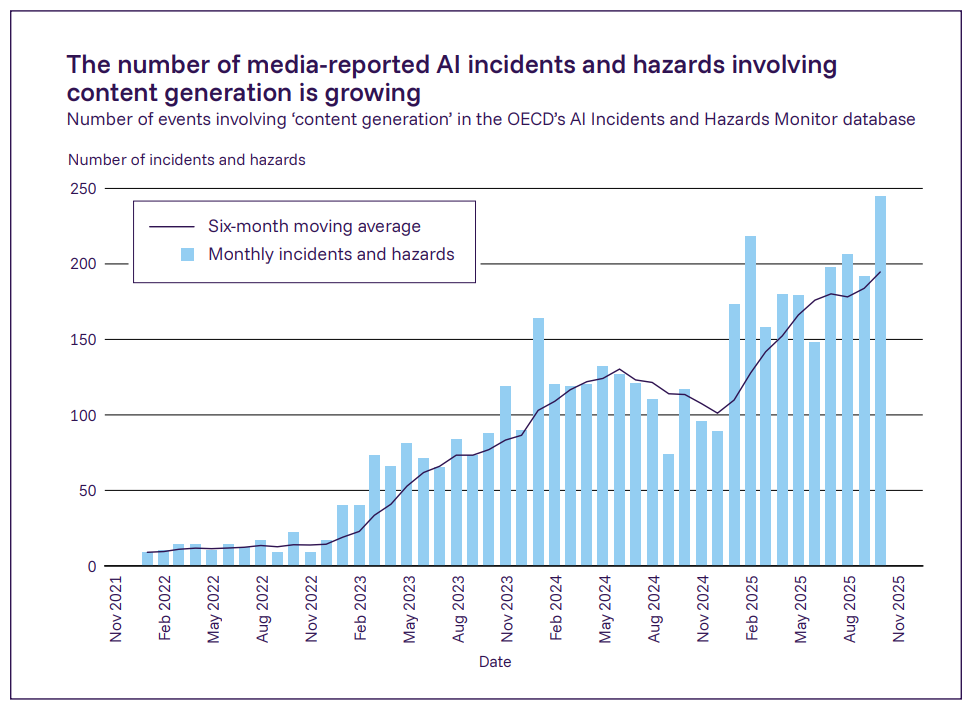
Deepfakes and Scams: The report confirms the alarming effectiveness of AI-generated voices, with listeners mistaking them for real human voices 80% of the time. This fuels a surge in scams, identity theft, and misinformation campaigns directly targeting US citizens.
Ransomware Surge: AI's role in optimizing attacks contributed to a 32% rise in identity-based attacks and a near 93% increase in data exfiltration volumes from ransomware families in 2025—a direct threat to American businesses and their data.
Informing US Governance and Regulation
The report's scientific evidence provides a critical foundation for US efforts to govern AI responsibly. Federal agencies like NIST (National Institute of Standards and Technology) and its CAISI (Center for AI Safety and Innovation) are actively developing frameworks for AI risk management. State-level initiatives, such as California's SB 942 (AI Transparency Act), which mandates clear labeling of AI-generated content, align directly with the report's calls for greater transparency to counter AI-driven deception. The report's findings will be instrumental in shaping future US legislation and industry standards.
Key Points of Note for a US Audience
1. The Jagged Nature of AI Intelligence
While AI models show impressive capabilities, their intelligence is jagged, they excel at difficult tasks but can fail at seemingly simple ones.
What it means: These are powerful but unpredictable tools. They can converse fluently in many languages and write functional software, yet struggle with basic reasoning about physical space or counting objects in an image. This jaggedness highlights the need for rigorous human oversight, even as capabilities increase.
2. The Risk Landscape: Malicious Use, Malfunctions, and Systemic Impacts
The report categorizes AI risks into three critical areas that demand attention from US leaders:
Malicious Use: The potential for AI to be exploited for scams, generate non-consensual imagery, and aid in cyberattacks or even the creation of biological/chemical weapons. This requires robust cybersecurity and intelligence counter-measures.
Malfunctions: The challenge of AI hallucinating (fabricating information) or acting autonomously as an agent without clear human control. This speaks to the need for stringent testing and human-in-the-loop protocols in US companies.
Systemic Risks: Broader societal threats, including widespread job displacement (especially in knowledge work) and threats to human autonomy through over-reliance on AI. This necessitates proactive workforce planning and ethical AI deployment strategies.
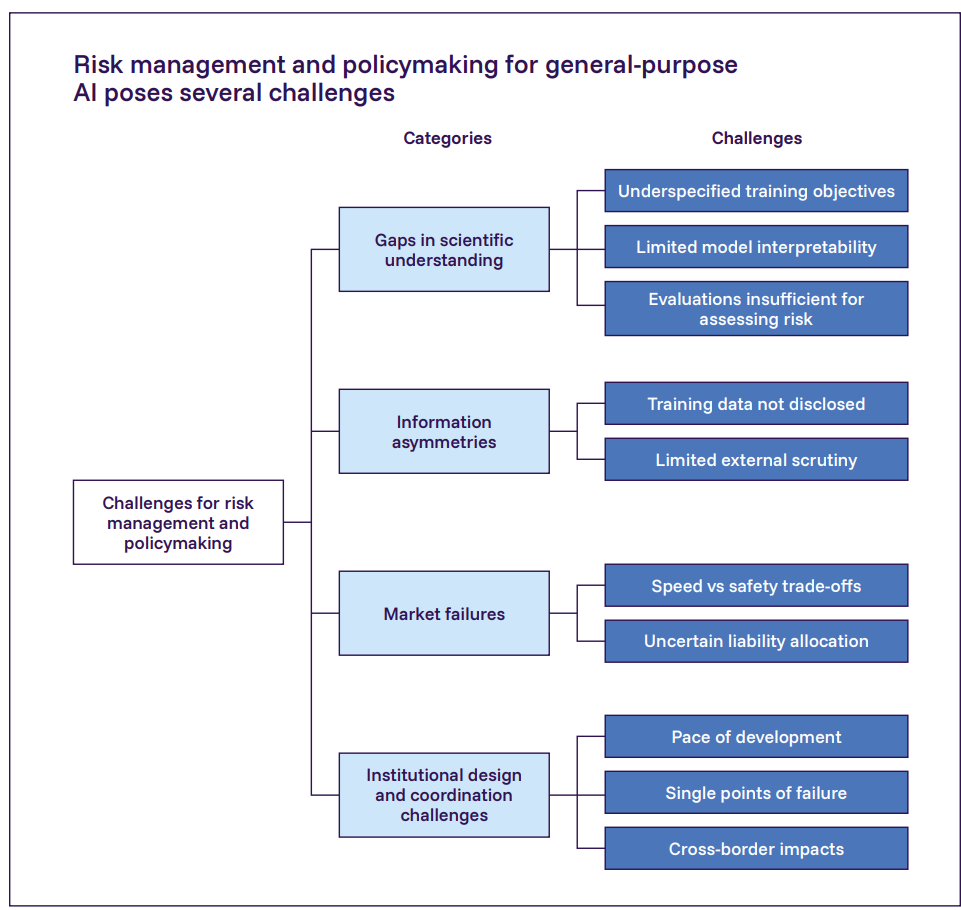
Source: International AI Safety Report 2026, Section 3.1Technical and institutional challenges
How We’re Building a Safety First Future for AI
If the International AI Safety Report 2026 is feeling like a heavy weather forecast so far, this second part is the roadmap for how we’re building the storm shelter. It’s easy to get overwhelmed by the risks, but the report makes one thing very clear: we aren’t just sitting ducks. Some of the brightest minds in the US and abroad are currently baking safety directly into the DNA of these systems as they evolve.
Think of it like the early days of the automobile. We didn't stop building cars because they were fast; we invented seatbelts, stoplights, and crumple zones. Here is how that safety engineering is happening for AI right now.
Defense-in-Depth
The report highlights a core concept called Defense-in-Depth. No single safeguard is perfect; every layer has holes, like a slice of Swiss cheese. But if you stack enough slices together, the holes don't line up, and nothing dangerous gets through.
Teaching AI to Say No: Through Adversarial Training, developers are essentially stress-testing AI, trying to trick it into giving harmful info so they can teach it to refuse those requests.
Invisible Guardrails: Real-time Content Filters act as a digital bouncer, scanning what the AI is about to say and blocking it if it looks like a hallucination or a malicious instruction.
Proactive Red Lines and Corporate Commitments
One of the most encouraging updates in the 2026 report is that safety is becoming a competitive standard for American companies. Twelve of the world’s biggest AI developers—including OpenAI, Anthropic, and Google DeepMind—have officially adopted Frontier AI Safety Frameworks.
The If-Then Rule: Companies are now publicly stating, "If our AI reaches this specific level of hacking ability, then we will automatically trigger these extra security protocols".
Independent Red-Teaming: Instead of just checking their own homework, firms are hiring independent Red Teams to try and break their models before they ever reach the public.
Using AI as Our Best Defender
We often worry about AI being used by hackers, but the report reminds us that AI is also our best shield.
The Zero-Day Hunter: AI agents are now being used to find and fix security flaws in our software faster than any human could, effectively patching the internet in real-time.
The Authenticity Badge: To fight deepfakes, we’re seeing a massive push for Watermarking and Metadata standards—digital signatures that prove a video or audio clip is actually human.
Building a Resilient Society
Finally, the report acknowledges that safety isn't just about the code; it’s about us.
Incident Reporting: Much like the black box in an airplane, we are building a global system to report AI near-misses and failures so the entire industry can learn from them.
Reskilling the Workforce: To handle the economic shifts, the report points to new public-private reskilling initiatives designed to help American workers transition into AI-augmented roles rather than being left behind.
❓ Frequently Asked Questions (FAQs)
Is it actually possible to make AI 100% safe?
In a word: No. The report is honest about the fact that as AI gets smarter, new unknown unknowns will emerge. The goal isn't zero risk but manageable risk, ensuring our defenses evolve as fast as the technology does.
Why should a business owner care about Defense-in-Depth?
Because it protects your bottom line. Using a CRM or an automated agent that follows these standards means you are far less likely to face a massive data breach or a legal headache caused by an AI hallucination.
What are these Red Lines I keep hearing about in AI?
Red lines are specific, measurable "no-go" zones. For example, a red line might be an AI’s ability to create a new biological pathogen. If a model shows it can do that in a lab setting, the developer is committed to stopping its release until it can be neutralized.
Discover how APE AI manages the creative power of LLMs with the guardrails necessary for professional sales environments. Explore our safety and logic protocols.
.svg)