.svg)
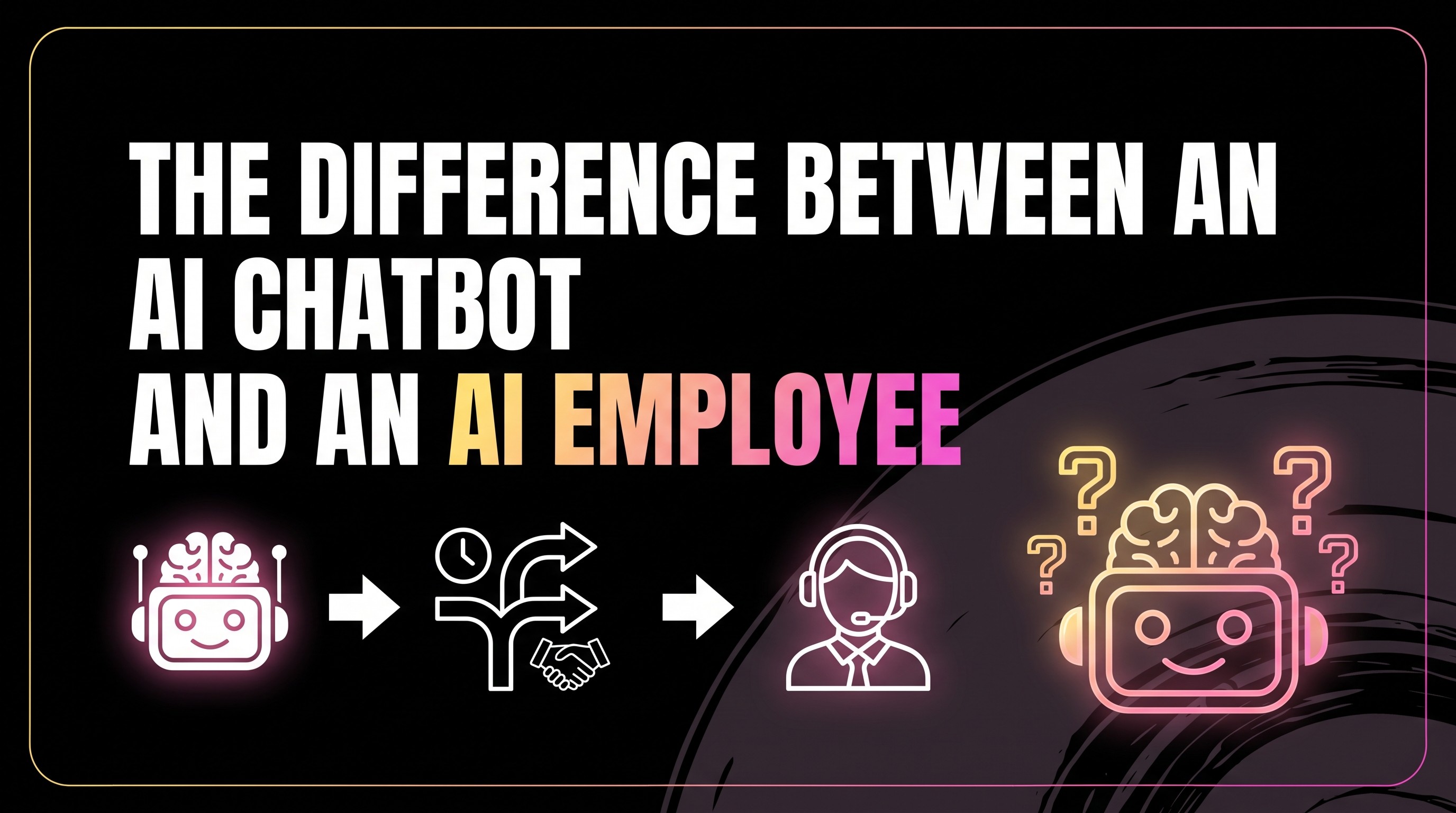
A chatbot answers a question. An employee handles a job. Here's what that distinction actually requires, and why the workforce is already living it.
TL;DR
"Chatbot" and "AI employee" get used almost interchangeably in casual conversation, and the difference between them is worth being precise about, because it's not just marketing language. It's the difference between something that answers a question well and something that can actually be trusted to handle an ongoing responsibility.
A chatbot, in the traditional sense, is built to respond to a single input with a single, appropriate output. Ask it something, it answers. That's a genuinely useful capability, and the distinction between a scripted chatbot and more flexible conversational AI is worth understanding on its own terms. But even a highly capable conversational AI answering one question well isn't the same thing as an employee handling a job. A job implies a beginning, a middle, and an end, often across multiple interactions, sometimes over days or weeks, with continuity expected the whole way through.
An employee remembers what a customer said last time, what was already promised, and what's still outstanding. A basic chatbot, answering each query in isolation, has no equivalent unless it's specifically built to retain and use that history. Without it, every interaction restarts from zero, which is fine for a single question and a real limitation for anything resembling an ongoing relationship.
Part of doing a job well is knowing the edges of your own competence, recognizing when a situation needs a person's judgment rather than pushing through with a best guess. That's a specific capability, not an automatic byproduct of being conversational. A system built to hand off cleanly when something's genuinely uncertain is doing something meaningfully different from one that always produces an answer regardless of confidence.
A chatbot's job is typically judged by whether the individual response was reasonable. An employee's job is judged by whether the actual outcome, the booked appointment, the resolved issue, the qualified lead, actually happened. That's a higher and different bar, and it requires the system to be built around outcomes rather than just conversational competence.
This isn't a hypothetical framing exercise. According to SalesAPE's 2026 workplace AI survey of over 250 US professionals, 81.1% of the workforce has already used some form of AI, official or unofficial, in 2026. AI at work has moved well past novelty into simple normalcy, which means the practical question for most businesses isn't whether to use it, but what kind of role it's actually being asked to fill.
The clearest signal of where this distinction is heading comes from a smaller group within that same survey: 13.5% of respondents already qualify as power users, relying on AI for more than five different work tasks daily. That's not someone occasionally asking a chatbot a question. That's someone who has effectively started treating AI as a colleague with a range of ongoing responsibilities, which is a meaningfully different relationship than the single-question, single-answer model most people still picture when they hear the word "chatbot."
If you're trying to figure out whether what you need is a quick-answer chatbot or something closer to an actual ongoing team member, that's worth working through directly rather than assuming one label covers both. SalesAPE offers a free demo if you'd like to see where that distinction actually sits, no pressure either way.
A chatbot typically answers a single question well, without necessarily remembering past interactions or being accountable for an ongoing outcome. An AI employee is built around memory across interactions, judgment about when to escalate, and responsibility for a full outcome, not just a single reply.
Not for every use case. A chatbot answering a single, standalone question can be genuinely useful without memory. Memory becomes necessary specifically when the goal is an ongoing relationship or a multi-step job, rather than a one-off answer.
Very common. According to SalesAPE's 2026 workplace AI survey, 81.1% of the workforce has used some form of AI, official or unofficial, in 2026, which reflects how far AI use has moved into daily, normal work behavior.
SalesAPE's survey defines power users as the 13.5% of respondents relying on AI for more than five different work tasks daily. This pattern reflects people already treating AI more like an ongoing team member with a range of responsibilities than a tool used for a single, isolated task.