.svg)
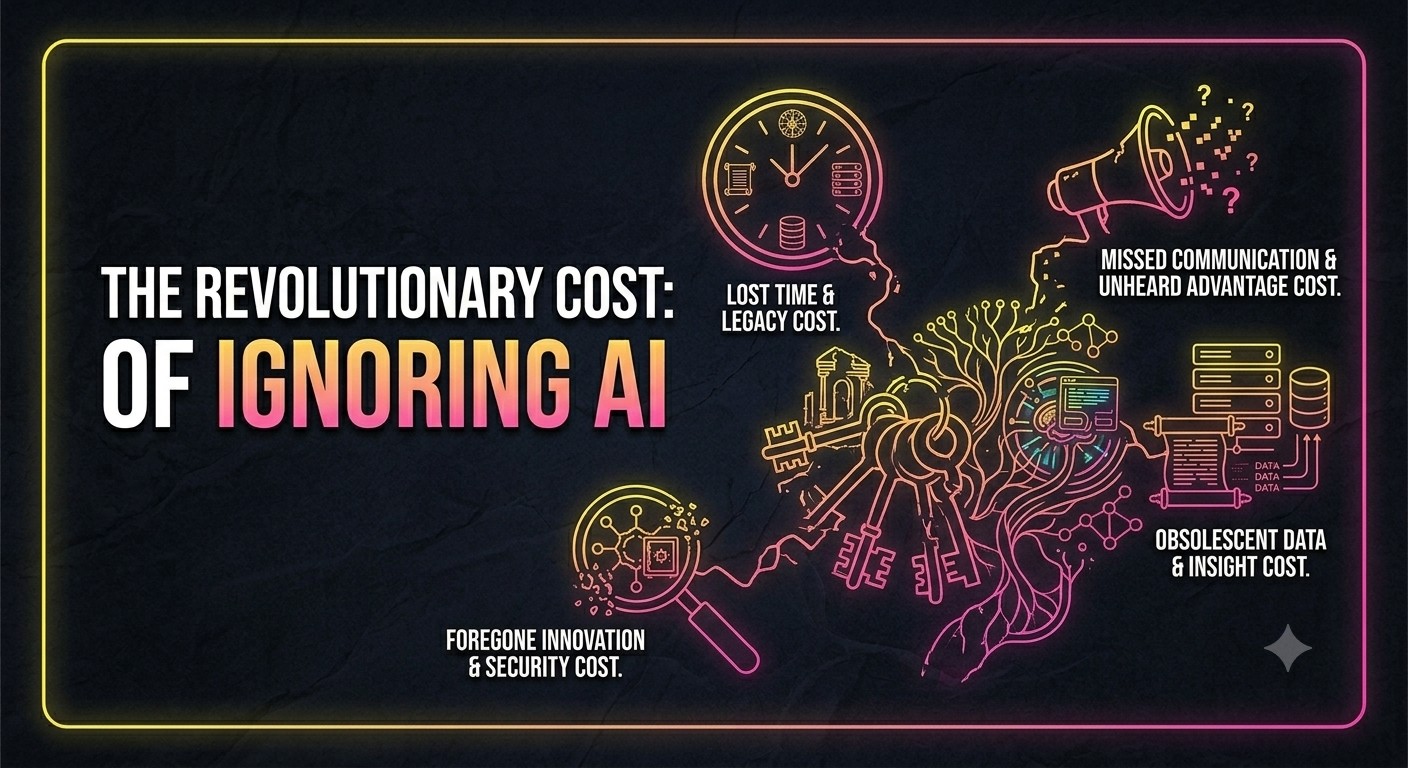
AI isn't a fad—it's a business revolution. Don't risk obsolescence like Blockbuster. Learn how to weave AI into your workflow to outpace the competition.
It’s easy to look back at the late 90s and early 2000s and laugh. Remember when we used to drive to a physical store to rent a plastic disc just to watch a movie? Or when we’d wait for a roll of film to be developed at the local pharmacy? Who remembers using a cassette tape to record their favourite songs as they came on the radio?
These things feel like ancient history now, but for the giants of that era, they were the foundation of multi-billion dollar empires. Those empires didn't crumble because of a lack of money or talent. They fell because they looked at a world-changing revolution and called it a fad.
Right now, we're standing at a similar crossroads. Artificial Intelligence isn't just a shiny new tool for your tech team; it’s a fundamental shift in how business gets done. Just as the internet changed how we shop and consume media, AI is changing how we talk to customers and grow our revenue.
If you think your business is too big or too established to be disrupted, or if you think you can’t afford to invest in AI, history has a few cautionary tales you'll want to hear.
Take Blockbuster, for example. In 2000, they had the chance to buy a struggling little startup called Netflix for just $50 million. They laughed at the offer. They were so focused on their profitable late fees that they couldn't imagine a world where people would stream movies directly to their living rooms. By the time they realized the internet wasn't going away, it was too late. They filed for bankruptcy in 2010 while Netflix went on to redefine global entertainment.
Kodak is another classic example of the innovator's dilemma. They actually invented the first digital camera in 1975. But instead of leaning into the future, they suppressed the technology to protect their high-margin film business. They chose the comfort of the present over the potential of the future. Today, Kodak is a shadow of its former self, having filed for Chapter 11 in 2012. These stories aren't just about bad luck; they’re about a failure to adapt to a changing environment.
You might be thinking, "That was the internet; AI is just a chatbot." But the data suggests otherwise. According to a 2024 McKinsey report, AI adoption in marketing and sales has more than doubled since 2023. These aren't just experiments; they are core business shifts. McKinsey estimates that generative AI could add between $2.6 trillion and $4.4 trillion in annual value to the global economy.
The companies winning today aren't just using AI to write emails faster. They're using it to rethink their entire workflow. High performers are three times more likely than their peers to be scaling the use of AI agents to handle complex tasks. While 80% of businesses are struggling to see a tangible impact on their bottom line, the top 20% are pulling ahead by integrating AI into the very fabric of their operations.
Did you know…
88% of organizations report they're now regularly using AI in at least one business function
AI high performers are nearly 3x as likely as others to have fundamentally redesigned their individual workflows to accommodate AI, rather than just bolting it on to old processes
Over 50% of organizations are now using AI in three or more business functions - it’s no longer just a chatbot!
TL;DR - AI isn’t another tool or piece of software to bolt onto an existing department, it’s a service that can and should be woven into the fabric of your organization.
In the sales world, the "internet moment" is happening right now. For years, sales development has relied on humans doing the heavy lifting—finding leads, qualifying them, and answering the same basic questions over and over. It’s a model that’s ripe for disruption because it’s slow, expensive, and doesn't scale.
Just as Borders outsourced their online sales to Amazon and lost their customer data, businesses that ignore AI sales agents are effectively handing their future leads to more agile competitors. Our own research here at SalesAPE showed that 81.1% of people are comfortable with AI handling initial lead qualification. If you're still relying on manual processes for every inbound lead, you're not just moving slower—you're falling behind.
TL;DR - AI is already viewed as common practice in the US, if you’re not already using it, you’re already one step behind your competitors.
At SalesAPE, we’ve seen what happens when businesses embrace the shift. Our AI sales agents aren't just bots; they’re designed to mimic your best SDRs. They handle the grunt work of qualifying leads and answering FAQs, so your human experts can focus on what they do best: closing deals. It’s about saving your resources and maximizing your conversions without losing that personal touch.
The internet revolution showed us that even the biggest apes in the jungle can fall if they don't move with the times. Don't let your business become a ‘what happened?’ story. The AI revolution is here, and it’s moving faster than the internet ever did. It’s time to stop watching from the sidelines and start leading the pack. Your future self (and your bottom line) will thank you for it.
It usually comes down to ‘The Innovator’s Dilemma.’ Established giants like Kodak or Blockbuster aren't incompetent; they're protective. They often have high-margin revenue streams (like film sales or late fees) that a new technology threatens to cannibalize. Management often chooses to protect today’s guaranteed profits rather than investing in tomorrow's uncertain ones. In the AI era, this looks like companies sticking to manual processes because they’re tried and true, even as more agile competitors lower their costs and speed up their response times using automation.
Both represent a shift in the infrastructure of business. The internet didn't just give us email; it changed how we manage supply chains, find customers, and distribute products. Similarly, AI isn't just about chatting; it’s a fundamental change in how data is processed and how labor is allocated. Much like the early 2000s, we are seeing a divide between companies that treat the technology as a side project and those that weave it into their core operations to create a permanent competitive advantage.
Bolting on AI means using it as a standalone tool—like having a team use a chatbot to help write an occasional email while keeping the rest of their workflow exactly the same. Weaving it into the fabric means redesigning your processes so that AI handles the high-volume, repetitive tasks from the ground up. According to the 2025 McKinsey report, the high performers are the ones who fundamentally redesign their workflows to let AI take the lead on initial data processing and customer interaction, freeing their human talent for high-value strategy (McKinsey, 2025).
History shows that technology rarely eliminates the need for humans; it shifts where those humans are most valuable. When the internet made it possible to buy books online, it didn't stop people from wanting expert recommendations—it just changed the medium. In sales and service, AI is designed to handle the grunt work of qualification and basic inquiry. This actually preserves the human touch for the moments where it matters most: complex problem solving, relationship building, and closing high-stakes deals. Moving to AI is about removing the robotic tasks from your people, not removing the people from your business.