.svg)
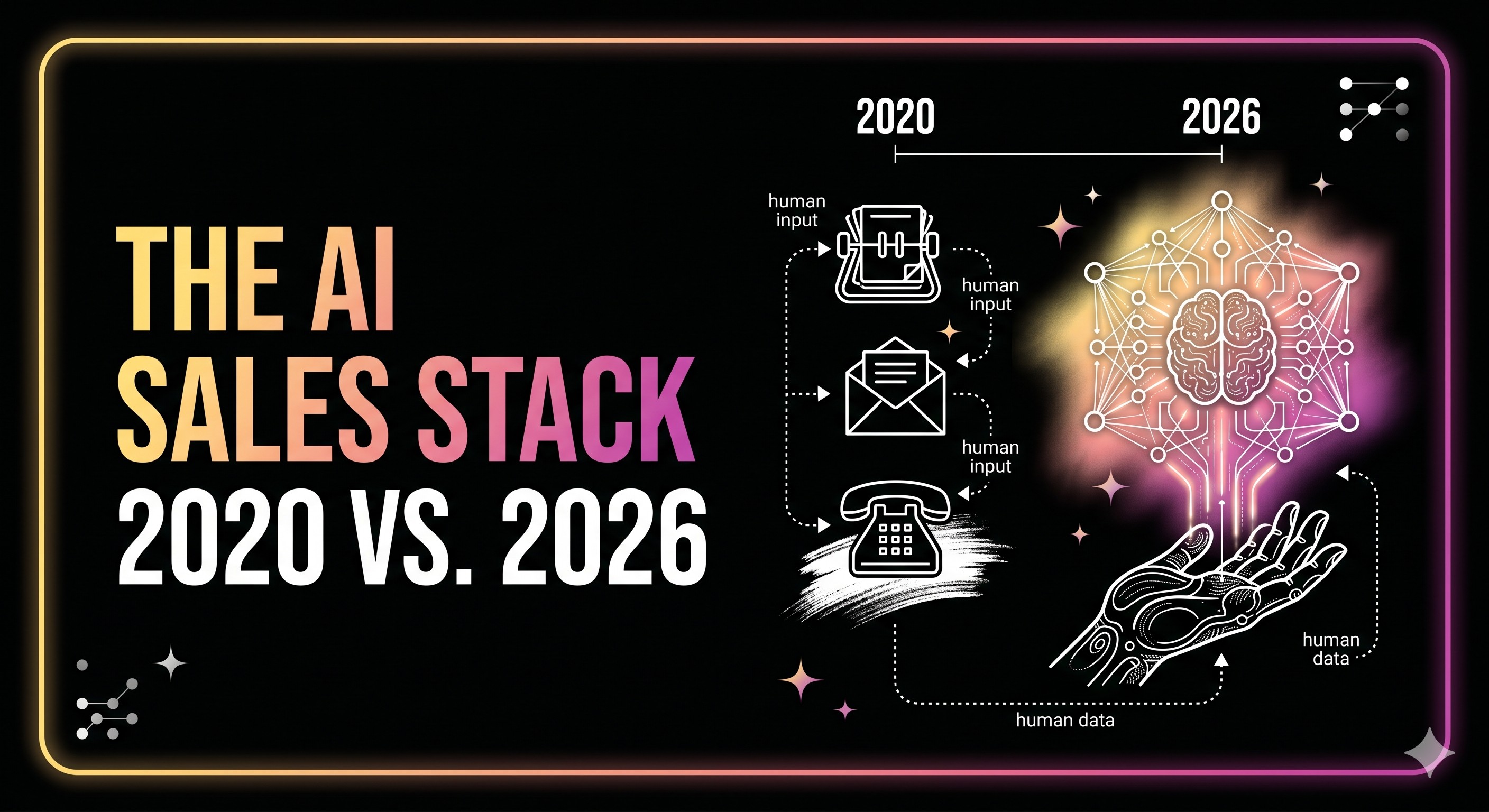
Upgrade your sales stack from obsolete 2020 automation to 2026's agentic AI. Stop spamming with sequencers and start closing deals with hyper-personalization.
If you step back to 2020, the cutting edge of sales looked a lot like a digital assembly line. We were obsessed with volume. We bought tools that helped us blast out more emails, make more cold calls, and spray and pray our way to a quota. It was the era of the sequencer, and for a while, it worked.
But six years is an eternity in tech. Today, those same tools aren’t just ineffective—they’re active liabilities. The market has shifted from mass automation to hyper-personalized execution. If your sales stack still looks like a 2020 wishlist, you aren’t just behind the curve; you’re likely spamming your best prospects.
In 2020, a personalized email meant a tool that could automatically pull a first name tag from a spreadsheet. Fast forward to 2026, and according to Ahrefs' latest research on Generative Engine Optimization (GEO), search engines and email filters have evolved to sniff out low-effort automation instantly.
The basic email sequencer is officially obsolete. It has been replaced by AI agents that don't just fill in the blanks but actually research a prospect’s recent LinkedIn activity, quarterly reports, and industry news to craft a unique opening. Our own 2026 AI Adoption Survey found that 54.1% of customers value a 60-second response from an AI agent, but only if it’s helpful. A generic, automated touching base email now has a higher chance of landing you on a blacklist than landing you a meeting.
Six years ago, your CRM was essentially a glorified filing cabinet. You spent half your Friday manually logging calls and updating deal stages. In the Gartner Hype Cycle for Emerging Technologies, we’ve moved past the peak of generative AI and deep into the era of autonomous agents.
In 2026, if you’re still manually entering data, you’re losing money. Modern AI sales agents handle the triage, the qualification, and the CRM management simultaneously. This shift is reflected in the bottom line: Morgan Stanley Research indicates that AI adopters saw an average EBIT margin expansion of 310 basis points between 2024 and 2025. They didn't get there by hiring more data entry clerks; they got there by making their workflows act on their own.
The most significant change since 2020 isn't the software—it’s the psychology of the buyer. Back then, we tried to hide our bots. Today, transparency is the ultimate sales tool. Our survey data shows that 75.7% of people find it positive or neutral when an AI identifies itself as a bot immediately.
Buyers in 2026 have no patience for faking it. They want speed for the qualification (where 81.1% are comfortable with AI) and expertise for the close (where 89.2% demand a human). The obsolete stack is the one that tries to trick the customer. The modern stack is the one that uses an AI agent to clear the path for a human expert to provide real value.
Is your current sales stack holding you back? Ask yourself these three questions to see if you're carrying 2020 baggage into a 2026 market:
If your team still has to manually click send on a sequence or move a lead from one stage to another to start a process, you're missing out on the 3–5 hours per week that 32.4% of workers are now reclaiming through agentic automation.
Does your AI just summarize what happened (read-only), or can it actually update your CRM, book a calendar invite, and send a follow-up (write-capable)? If it can't act, it's a chatbot, not an agent.
Does your outreach rely on static tags like company name, or does it utilize real-time data to mention a prospect’s specific pain points? If it’s the former, you’re likely being filtered out by modern AI-driven spam filters.
Email providers now use advanced AI to detect pattern-based automation. Because sequencers send the same structure to hundreds of people, they are easily flagged. Modern AI agents generate unique structures for every recipient, making them much more likely to reach the inbox.
According to Google Cloud, 88% of agentic AI early adopters report positive ROI. By reclaiming the 16.2% of time that sales pros previously spent on manual work—more than 5 hours a week—teams can focus entirely on high-value closing conversations.
The agentic handover should happen at the specific solution phase. Our data shows 66.7% of sales pros want the AI to handle the qualifying and booking, leaving the human to handle the final 10% of the deal where expertise and empathy are required.
While there is an initial setup, the cost of doing nothing is higher. Morgan Stanley Investment Management estimates an annual labor expense reduction of over $200 billion for companies that automate half of their high-probability manual roles.
Don't let legacy tech be the silent killer of your SME growth. The difference between a 2020 stack and a 2026 stack is the difference between checking in and closing deals.
Book a Demo to see what a modern agentic stack looks like, or email us at hello@salesape.ai to start your Tech Debt Audit.