.svg)
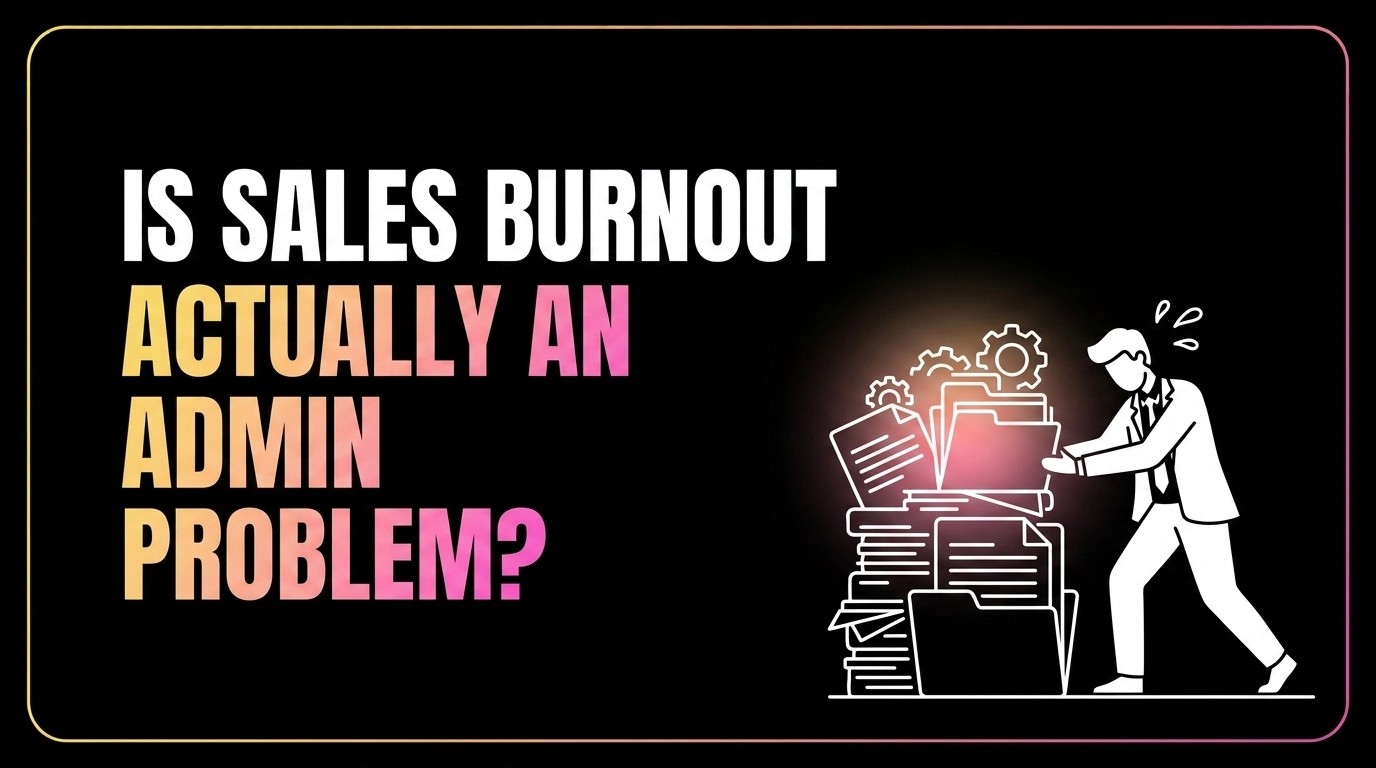
Burnout gets discussed as a personal resilience issue. Often, it's a support gap, and closing it is a legitimate management responsibility.
TL;DR
Sales burnout usually gets framed as something happening to an individual, someone who's struggling to keep their energy up, manage rejection, or sustain their pace. That framing isn't wrong, but it's often incomplete. A real, sizable part of what gets labeled burnout is the accumulated weight of everything around the actual selling, the logging, the updating, the reporting, the follow-up admin that has to happen regardless of how a call went. That's worth separating out clearly, because the two problems need different responses.
Selling itself, even when it's demanding, is usually the part of the role people signed up for and often still find genuinely engaging. What tends to wear people down is everything else layered on top: updating records after every call, chasing internal information, reconstructing what happened in a conversation hours after it ended. None of that is "the job" in the sense most reps mean when they talk about liking or not liking their work. It's overhead sitting on top of it, and overhead is squarely something a team's structure and tools can address, rather than something an individual is expected to simply manage better.
It's worth being direct about something here rather than presenting AI as an uncomplicated fix: according to SalesAPE's 2026 workplace AI survey of over 250 US professionals, 32.4% of employees report feeling more productive but more stressed, specifically because of how much faster everything now moves. That's a real cost, not a minor footnote, and it deserves to be named plainly rather than talked around. Speed without support can just as easily raise pressure as relieve it, and treating this as an automatic win for everyone involved wouldn't be honest.
The same survey also found that 37.8% of respondents say AI has improved their work-life balance, specifically by reducing the evening catch-up work that used to spill into personal time. That's a meaningfully different outcome than the stress finding above, and the difference seems to come down to what the AI is actually being used for. Relief tends to show up when AI removes genuinely low-value administrative work, the logging, the reconstructing, the catching-up, rather than simply accelerating the pace of everything across the board.
This distinction matters for how a manager thinks about supporting a team that's showing signs of strain. The question worth asking isn't "how do we make the team more resilient," it's "how much of what's wearing people down is actually the selling, versus how much is the administrative weight sitting on top of it." If it's meaningfully the second, that's a solvable structural problem, and addressing it is a legitimate part of a manager's job, not something to leave to individual coping strategies. A team supported well enough that admin stops eating into personal time looks a lot like the 37.8% outcome above. A team where speed keeps increasing with no corresponding relief looks more like the 32.4% one. Which direction a team ends up in has a lot to do with deliberate choices made above them, not just how well individuals happen to cope.
Tools that specifically target the admin side, handling inbound qualification and routing so reps aren't the ones logging and chasing it, are one part of how that gap actually gets closed for a team. SalesAPE is built around that distinction directly.
Often something else. A meaningful portion of burnout comes from administrative overhead, logging, reporting, chasing information, layered on top of the actual selling, rather than the core sales work itself. Separating the two matters for figuring out what actually needs to change.
The picture is mixed. According to SalesAPE's 2026 workplace AI survey, 32.4% of employees feel more productive but more stressed due to the increased pace AI has introduced. It genuinely depends on what the AI is being used for and how deliberately that's managed, not an automatic outcome either way.
Primarily around administrative work. The same survey found 37.8% say AI has improved their work-life balance specifically by reducing evening catch-up work, suggesting the relief comes from removing low-value admin rather than simply making everything move faster.
This is a legitimate management and structural responsibility, not something individual reps are expected to solve through personal resilience. Identifying how much strain comes from admin overhead versus the sales work itself, and addressing that overhead directly, is squarely a leadership decision.