.svg)
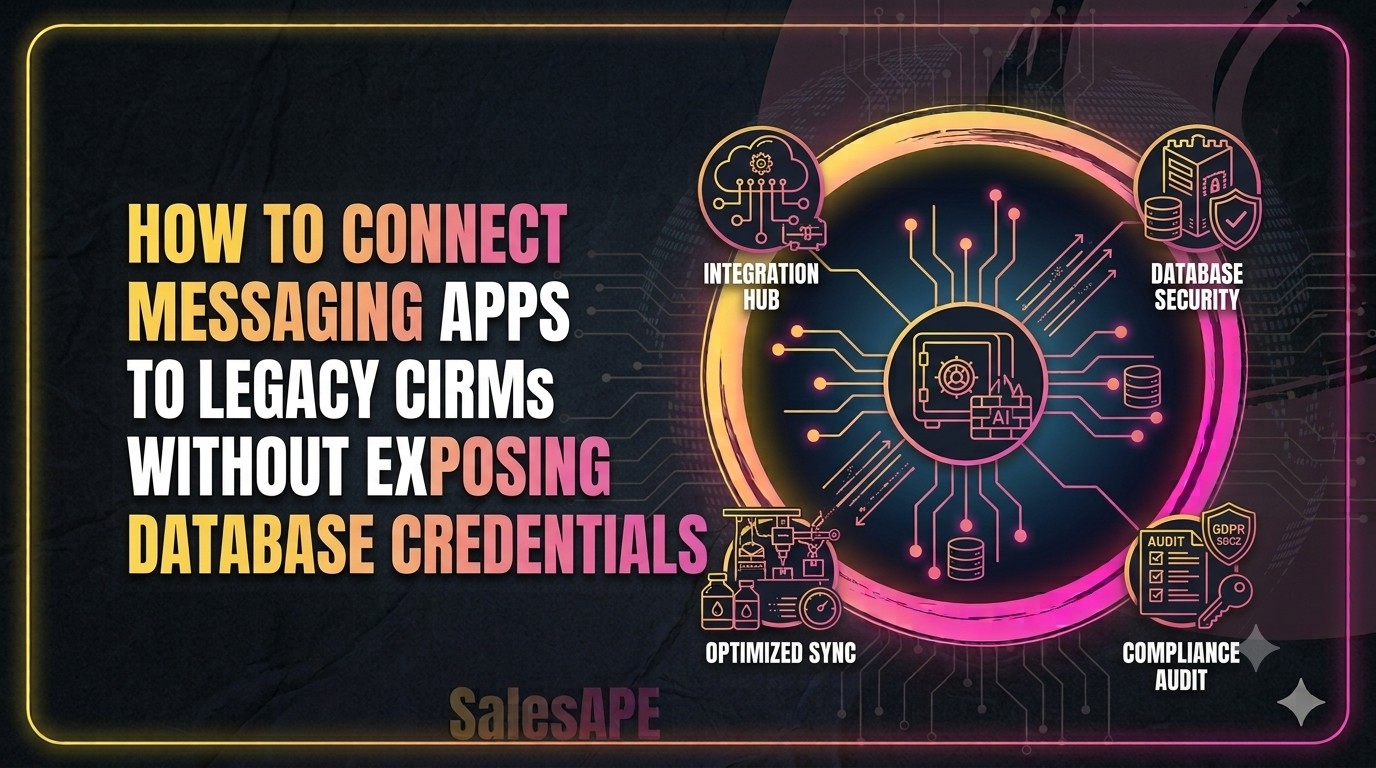
Learn how to connect messaging apps to legacy CRMs without exposing database credentials using isolated API bridges and conversational AI.
As commercial enterprises scale, they face a common technical challenge: bridging the gap between modern customer communication channels and legacy infrastructure. Inbound leads, quote requests, and order inquiries flow constantly across SMS, WhatsApp, and web messaging. To process these inquiries efficiently, external messaging tools require access to customer records, custom pricing tiers, and order histories stored in legacy Customer Relationship Management (CRM) databases.
However, connecting cloud-based messaging interfaces directly to legacy CRM software introduces significant cybersecurity risks. Legacy systems often lack granular access controls, tokenization protocols, and zero-trust authentication mechanisms required by modern IT security standards. Hardcoding master database logins or exposing internal CRM ports to third-party messaging tools leaves your core infrastructure vulnerable.
“Securing data credential pathways while maintaining real-time pipeline velocity is essential for enterprise risk management.”
Connecting external messaging applications directly to legacy databases compromises enterprise governance. According to research from the IBM Cost of a Data Breach Report, compromised credentials and third-party vendor entry points remain among the most costly initial attack vectors, with supply chain breaches taking months to detect and isolate. Furthermore, findings from the Okta Identity Governance Enterprise Report show that managing non-human credentials and API access paths is critical as enterprise applications expand.
When legacy CRMs are linked to external messaging channels without isolated credential pathways, several structural vulnerabilities arise:
Forcing your IT department to choose between fast customer communication and strict credential security creates operational bottlenecks that slow down your entire sales organization.
Resolving this security challenge requires decoupling external messaging layers from your central database. Rather than granting direct network or database access, enterprise architectures use isolated API gateways and tokenized middleware.
A private conversational AI platform operates as a secure intermediary between your prospects and your legacy CRM. Operating over SMS, WhatsApp, and email, the platform handles customer interactions externally. When an inbound inquiry requires account verification or stock pricing, the assistant queries the legacy CRM through a scoped, read-only API bridge. The bridge validates the request using single-use security tokens, retrieves only the requested data fields, and returns the response to the customer. Research highlighted in the Gartner Third-Party API Security Governance Report confirms that implementing fine-grained, scoped authorization pathways prevents credential exploitation and protects backend infrastructure.
Protecting legacy credentials behind isolated API bridges allows your business to automate customer intake while maintaining complete enterprise security. Delivering real-time answers over messaging channels eliminates credential friction and accelerates revenue growth.
Data from our SalesAPE 2026 AI Adoption Survey demonstrates that 56.8% of business leaders view execution speed as the single greatest advantage of conversational automation. Furthermore, 54.1% of prospective buyers prefer an immediate, automated 60-second response over waiting for manual account verification or portal logins. Isolating your legacy CRM credentials behind a read-only conversational assistant protects your core infrastructure, satisfies strict compliance mandates, and keeps your commercial sales pipeline moving at maximum velocity.
Ready to secure your data credential pathways and automate legacy CRM integration without compromising enterprise security? We promise no high-pressure sales routines, zero automated marketing spam tracking, and no unsolicited phone calls. You can explore a live view of our private platform through our online scheduling system or reach out directly to our security and integration team at hello@salesape.ai to review our isolated architecture protocols.
The bridge acts as a secure buffer, using short-lived, single-use security tokens to retrieve specific data points without ever exposing master database logins or system credentials to external applications.
Yes, your IT administrators maintain total control over access permissions, setting explicit rules regarding which database tables, pricing structures, and record fields the assistant can query.
No, the platform queries your CRM using scoped, lightweight API requests or read-only mirrors, ensuring high-speed data retrieval without impacting legacy system performance or stability.