.svg)
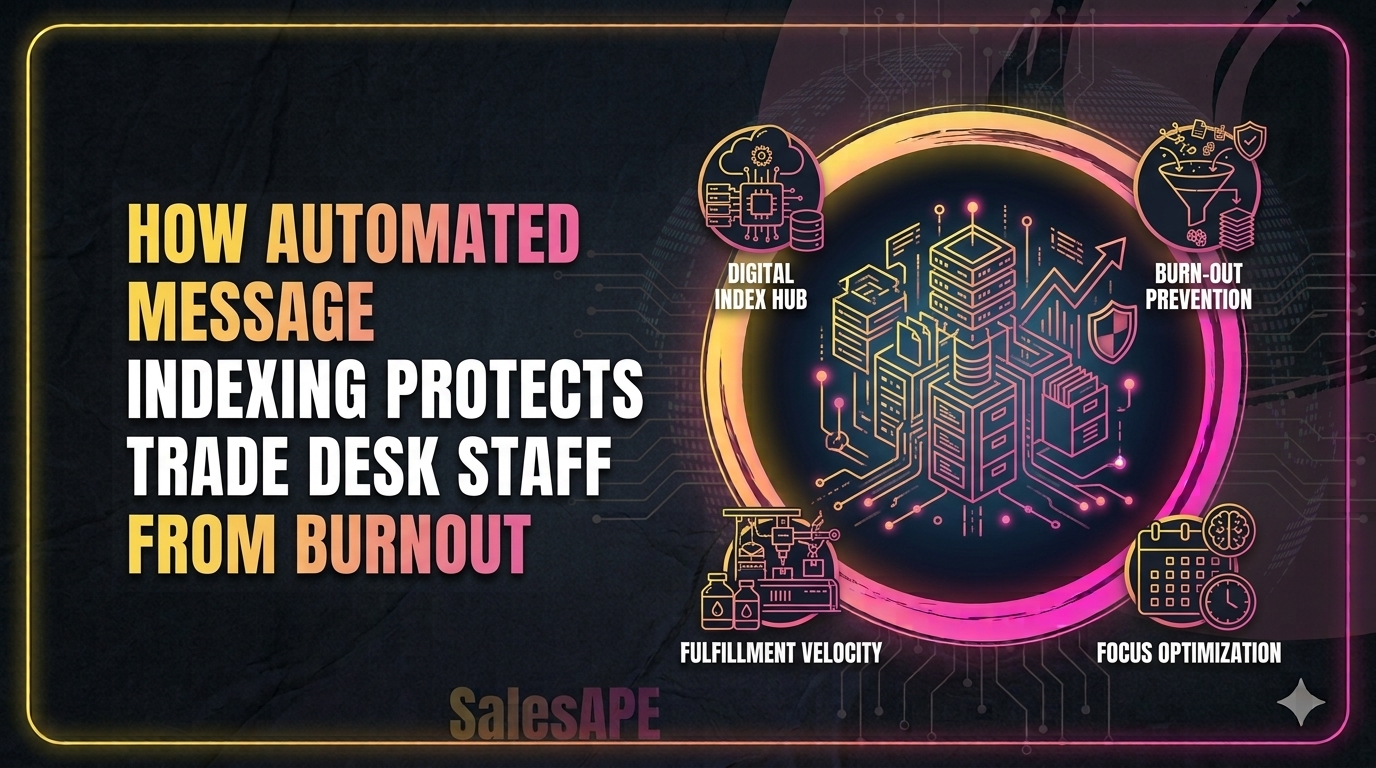
Discover how automated incoming message indexing protects trade counter staff from burnout, streamlines order triage, and improves staff retention.
For commercial trade merchants, distributors, and industrial supply yards, skilled trade desk staff are the lifeblood of customer retention. Experienced counter managers and account executives hold deep product knowledge, understand complex contractor pricing agreements, and build long-term relationships with regional builders. However, trade merchants face a growing internal crisis: high employee turnover driven by daily administrative burnout.
As trade buyers shift their communication from face-to-face counter visits to constant digital messages, trade desk staff are flooded with inbound inquiries across personal SMS, WhatsApp threads, and shared email inboxes. Staff spend hours every day manually copying order numbers, looking up stock codes, and rekeying handwritten takeoff sheets into enterprise systems. Automating incoming message indexing resolves this administrative burden, allowing merchants to protect their experienced staff and stabilize turnover metrics.
Relying on manual message triage creates severe operational stress for frontline teams. According to workplace research detailed in the Paycor Employee Burnout Statistics Report, over 76% of employees experience job burnout at least occasionally, with overworked staff being 2.6 times more likely to actively look for a new employer. Furthermore, operational findings from the Salesforce State of Service Report indicate that 79% of service and field operations leaders prioritize automated digital workflows to eliminate repetitive administrative friction and retain key personnel.
When trade desk staff are subjected to manual message overload, several organizational issues develop:
If your trade counter team spends most of their working shift copying text messages into your enterprise software, administrative fatigue will directly drive up your staff turnover rates.
Automated message indexing transforms raw, unstructured customer communications into organized operational data. Operating as an intelligent middleware buffer, a private conversational AI platform receives incoming messages across SMS, email, and messaging apps, automatically identifying key order parameters.
Instead of requiring human reps to manually sort through inbox backlogs, the automated indexing engine extracts core details, such as manufacturer part numbers, fitting dimensions, quantity requirements, and requested delivery windows. Workflow research from the Zapier AI Automation Report confirms that lead and order automation eliminates manual workflow delays, freeing staff to focus on high-value tasks. The indexed data is structured into a clean digital order brief, allowing desk staff to review and approve transactions in seconds.
Eliminating repetitive administrative tasks transforms the trade desk role from manual data entry to strategic account management. Giving frontline staff modern automation tools boosts job satisfaction, stabilizes retention metrics, and keeps experienced team members engaged.
Data from our SalesAPE 2026 AI Adoption Survey confirms that 56.8% of business leaders view execution speed as the primary benefit of conversational automation. Furthermore, 54.1% of commercial buyers prefer an immediate, automated 60-second response over waiting hours for a manual callback. Automating incoming message indexing protects your team from daily burnout, strengthens your workplace culture, and ensures your trade business retains its most valuable asset: experienced trade desk professionals.
Ready to protect your trade counter staff from message burnout and improve employee retention metrics? We promise no high-pressure sales routines, zero automated marketing spam tracking, and no unsolicited phone calls. You can explore a live view of our private platform through our online scheduling system or reach out directly to our team at hello@salesape.ai to discuss your trade counter workflows.
Automated message indexing uses intelligent natural language processing to read incoming customer texts, WhatsApps, and emails, automatically extracting key order details and matching them directly against your inventory database.
By removing repetitive data entry, manual stock checks, and inbox chaos, staff spend their working hours on high-value customer interactions and strategic sales, directly reducing workplace burnout and turnover.
Yes, the system uses secure API pathways to pass structured order briefs and customer account details directly into your current CRM or ERP software without requiring manual rekeying.