.svg)
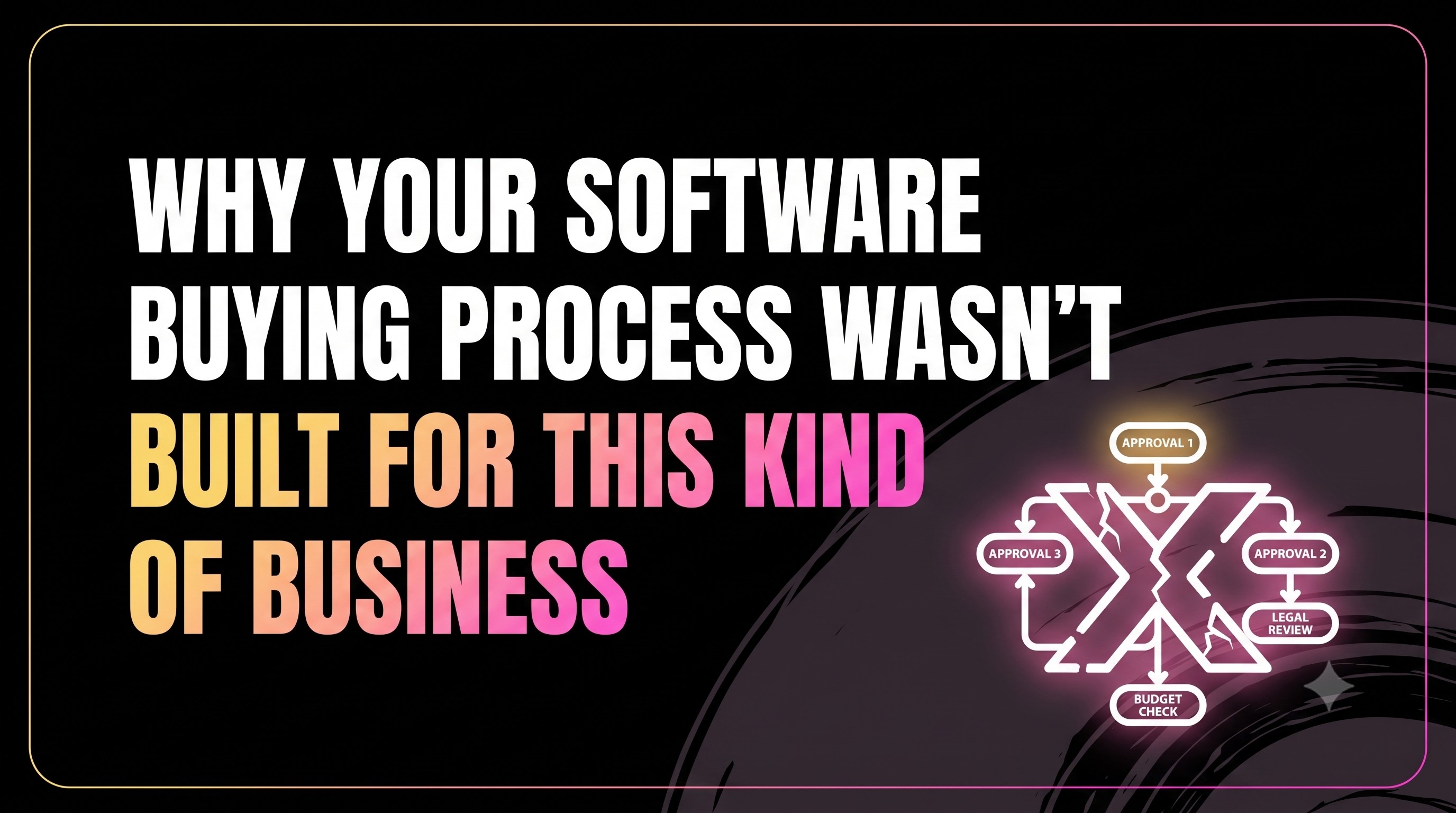
Corporate software procurement assumes committees and slow evaluation. Here's why that breaks for service and trade operators, and what works instead.
TL;DR
Somebody on your team found a tool that would fix a real problem. They ran a demo. They liked what they saw. Then it sat in a folder for six weeks while nothing happened.
That's not a them problem. That's a procurement process problem, and it happens because most software buying processes are built for a business that doesn't look like yours.
Enterprise software procurement assumes a few things: a dedicated IT function, a budget owner who's in every meeting, and a buying committee with the bandwidth to run a multi-week evaluation. That model works fine if you've got 500 employees and a procurement department.
It doesn't work if you run a construction company, an HVAC business, a fleet operation, or any service business where the person closest to the problem isn't the person who signs the check. In these businesses, the owner is often on a job site, with a client, or running the parts of the operation that actually make money. The person evaluating the software is usually an operations manager, a lead scheduler, or whoever got tired of watching leads slip through the cracks. They're not the budget holder. They're the person trying to bring the budget holder a solution good enough to say yes to.
That mismatch is the root of most failed procurement cycles in this segment. The process assumes a buyer who has time to run an evaluation. The real buyer has fifteen minutes between calls.
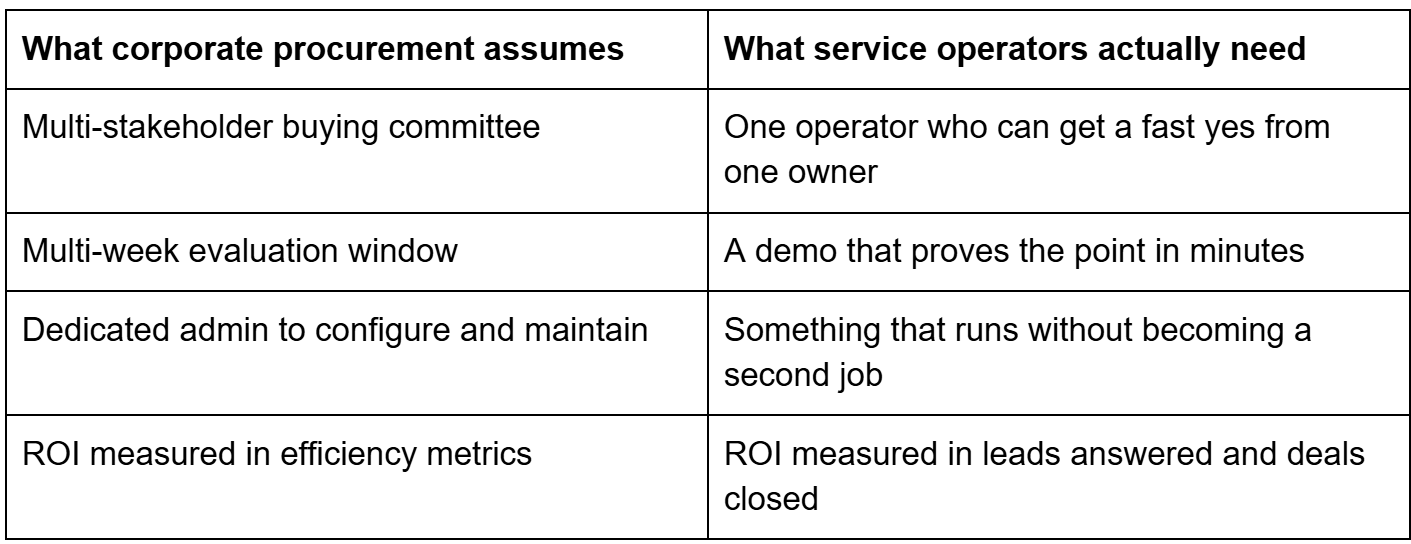
A standard SaaS sales process wants a champion, an economic buyer, a technical evaluator, and sometimes a legal reviewer, all in the room before a deal moves. Service businesses often have one person doing all four jobs, and that person still needs the owner's sign-off before anything gets purchased. When a vendor's process assumes multiple stakeholders who don't exist, the deal stalls. Not because the business doesn't have the problem. Because the process doesn't match how the business actually makes decisions.
A missed after-hours lead doesn't wait for a six-week pilot. Neither does a call that goes to voicemail because nobody's at the desk. Corporate procurement timelines are built around minimizing risk on large, infrequent purchases. Service businesses are usually solving for a problem that's costing them money every single week the tool isn't in place. The longer the evaluation drags, the more the business absorbs a cost it's already decided it can't afford.
Plenty of tools get bought and never get used properly, because the rollout plan assumed a dedicated admin who'd configure it, train the team, and keep it running. In a lot of service businesses, that person doesn't exist. The operator who bought the tool is also running dispatch, following up with customers, and covering for whoever called in sick. If a tool needs a project manager to implement it, it's already lost this buyer.
The operators who successfully bring solutions to their owners aren't running formal RFPs. They're looking for something they can demo in five minutes, describe in one sentence, and point to a similar business already using. They want proof framed as revenue, not efficiency, because that's the language that gets a fast yes from an owner who's thinking about the P&L, not the software stack.
Service businesses close software decisions faster when the pitch fits in one sentence, the proof is a real result from a similar business, and the setup doesn't require a dedicated person to run it.
We Buy Any Motorcaravan ran into exactly this gap. Their sales team clocked off at the end of the day, but their customers kept enquiring into the evening. There was no internal capacity to build a formal evaluation process around fixing it. Once Abi was in place answering those after-hours enquiries, lead-to-reply conversion doubled and the business booked 71 additional calls a month, with no-shows cut by 80%.
Willow Tree Realty had the same structural problem in a different form. A new listing could bring in 250 messages overnight, and the team was only reaching about 30% of them. There was no six-week window to solve that. Once Abi took over responding to every enquiry, response coverage went from 30% to 100%, and the business saw a 10x return.
Neither business ran a formal procurement process. They evaluated something fast, saw a result that mattered to the person signing off, and moved.
If you're the one bringing a solution to your owner or your leadership team, the fastest path isn't a longer evaluation. It's proof you can show them in the next five minutes, from a business that looks like yours.
Book a demo and see how Abi handles this for businesses like yours: book a demo. No spam, no pressure, just a look at what it actually does. Or reach out directly at hello@salesape.ai.
Why does corporate software procurement fail for service and trade businesses?
Corporate procurement assumes a buying committee, a dedicated evaluator, and weeks of runway to compare options. Most service businesses have one operator doing that job alongside dispatch, scheduling, and customer follow-up, with an owner who isn't in every meeting. The process and the buyer don't match, so deals stall or never start.
Who actually evaluates software in a service or trade business?
Often an operations manager or lead scheduler, not the owner or CEO. This person can't authorize the spend themselves. Their job is to find something good enough to bring to the owner and get a fast yes, usually with a quick demo and proof from a similar business.
What makes a software rollout fail after it's already been purchased?
Implementation plans that assume a dedicated admin will configure and maintain the tool. In many service businesses, that person doesn't exist. If the tool requires ongoing technical management, the operator who championed it ends up doing a second job just to keep it running.
How should a service business evaluate a new tool without a formal RFP process?
Look for a demo that proves value in minutes, not weeks. Ask for proof from a business similar to yours, ideally with a concrete result like a response-rate or conversion-rate change. Confirm the setup won't require a dedicated person to keep it running.
What's the fastest way to get leadership sign-off on new software?
Bring a short, concrete demo and a result from a comparable business, framed as revenue rather than efficiency. Owners and executives at service businesses respond faster to "this got another company more booked calls" than to feature lists.