.svg)
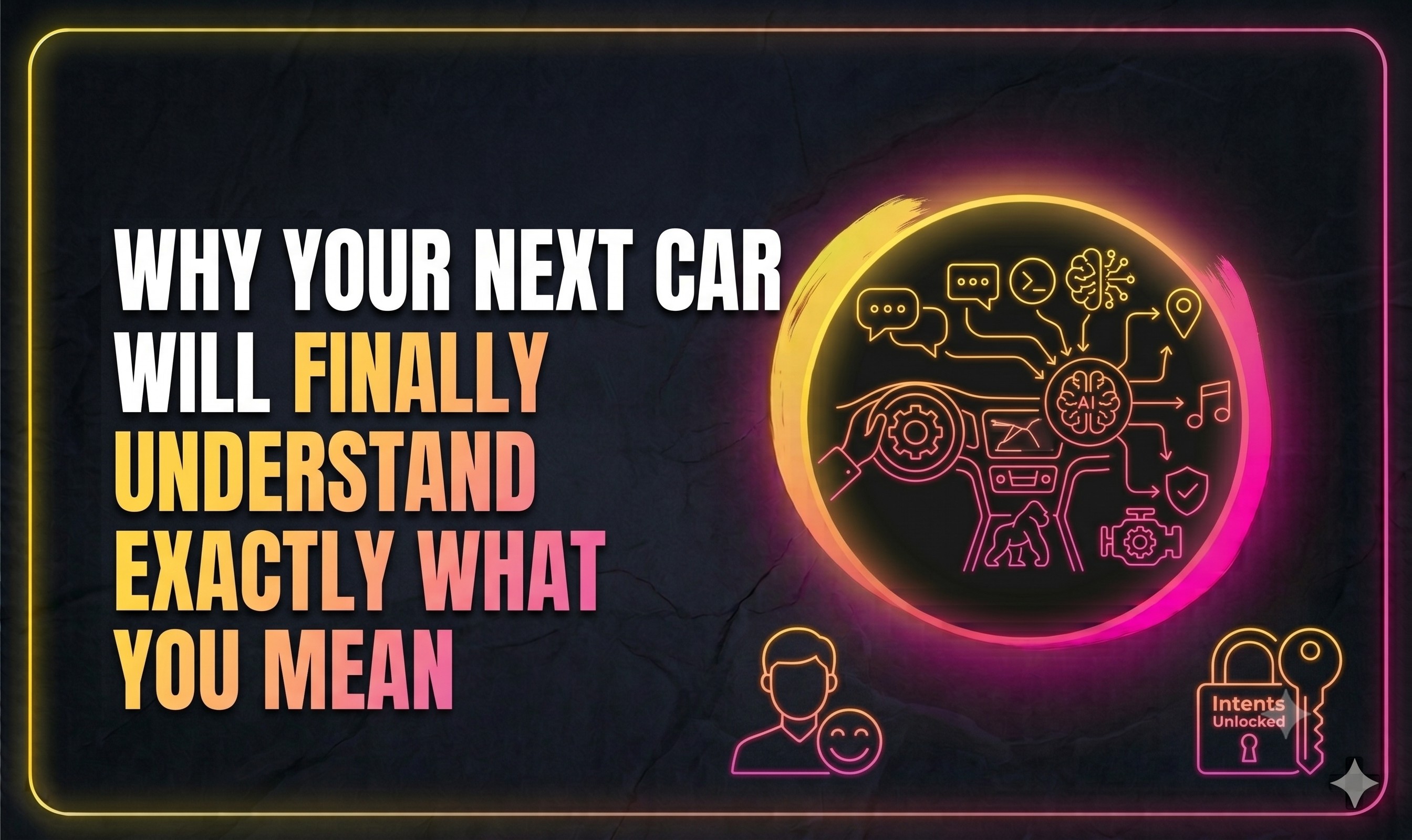
Discover how 2026 automotive technology is retiring rigid, frustrating voice-command systems in favor of natural, context-aware AI. Learn how modern vehicles act as proactive partners by anticipating your schedule and understanding conversational intent, making every drive more seamless and human-centric.
We’ve all experienced the deep irritation of shouting at a dashboard. You’re driving down the freeway, trying to navigate to a new restaurant or call a client, and you press the voice-activation button on your steering wheel. You speak clearly, but the legacy infotainment system drops the ball entirely, misinterpreting your accent, offering a completely unrelated map destination, or turning on the windscreen wipers instead. For over a decade, in-car voice tech felt less like a futuristic luxury and more like an exercise in extreme patience.
The problem was that old-school automotive systems relied on strict, command-based computing. They required you to memorize specific, rigid phrases and speak in a stiff, synthetic rhythm to match their internal code.
If you didn’t use the exact magic words, the interface simply broke down. But a massive technical shift has quietly taken over the automotive world, permanently retiring the mechanical command voice and changing how humans interact with their vehicles forever.
As we cross the midpoint of the decade, cars are undergoing a massive software-driven evolution. Major global automakers have formed powerful engineering alliances with tech giants, integrating advanced conversational models directly into the vehicle's physical architecture.
Platforms like the Qualcomm Snapdragon Digital Chassis are deploying hybrid edge-to-cloud systems that allow your car's dashboard to process language with the exact same nuance as a human companion. You no longer have to speak like a computer to get your car to listen.
Instead, you can speak completely naturally, use contractions, change your mind mid-sentence, and use implied context. You can casually say, "Hey, it's getting a little stuffy in here," and the car will smoothly lower the cabin temperature and adjust the airflow. The vehicle is learning to understand human patterns, removing the barrier between intent and execution.
The true magic of a modern vehicle assistant is its ability to connect multiple pieces of the puzzle silently beneath the surface of your drive. Because these models are integrated with your digital ecosystem, they don't just wait for you to issue an order; they understand the wider context of your day.
If you start your vehicle at 8:45 AM and you have a calendar commitment across town at 9:00 AM, the navigation doesn't wait for you to manually input the address. The car analyzes live traffic patterns, identifies a developing bottleneck on your usual route, and proactively speaks up.
It can tell you exactly how late you will be and offer to automatically message your contact with your updated arrival time, or smoothly ask if you would prefer to dial into the meeting via audio right from your dashboard. By taking over these minor administrative logistics, your car transforms from a passive piece of metal into an active partner that protects your time and keeps your day moving forward.
The rapid death of the command voice proves an incredibly valuable lesson about where modern technology is heading. Consumers have officially run out of patience for rigid, frustrating interfaces that require a user manual to operate. Whether you are adjusting your car's navigation during a busy morning commute or navigating a complex system at your office desk, the expectation is now identical: the interaction must feel seamless, intuitive, and entirely human.
When technology adapts to our natural ways of speaking and thinking, it stops feeling like an annoying chore and starts feeling like an asset. By offloading the friction of manual inputs and complicated menus, you clear away the digital noise. You give yourself the mental clarity to sit back, enjoy the drive, and focus on the road ahead.
Modern vehicle architecture uses a hybrid computing framework to guarantee continuous operation. Essential interior commands—like adjusting climate control, activating safety features, or parsing basic media requests—are processed locally on custom silicon chips built right into the dashboard. When your vehicle has access to a cellular network, it utilizes cloud infrastructure to handle data-heavy requests like live web routing, deep search queries, or real-time scheduling updates, ensuring your assistant never freezes when you drive through a remote area or a cellular dead zone.
Yes, modern automotive interiors utilize localized acoustic beamforming technology to isolate specific audio zones. Multiple microphones are strategically embedded throughout the cabin roof and pillars to pinpoint the exact geographic origin of a voice. If a passenger in the back seat discusses their weekend plans, the system filters out that audio data entirely. The interface locks onto the driver’s vocal footprint, ensuring that ambient cabin chatter never accidentally triggers a navigation change or disrupts an active communication workflow.
Enterprise systems operating within the US and European markets must comply with strict corporate governance frameworks and data-privacy standards. Onboard voice assistants operate on a local token triggers system, meaning the microphone isolates its audio processing to a closed loop until it detects your specific wake phrase. Contractual user agreements ensure that ambient cabin conversations are never uploaded, stored, or reviewed by external providers, giving professionals absolute confidence that their private business discussions remain entirely confidential inside the vehicle.