.svg)
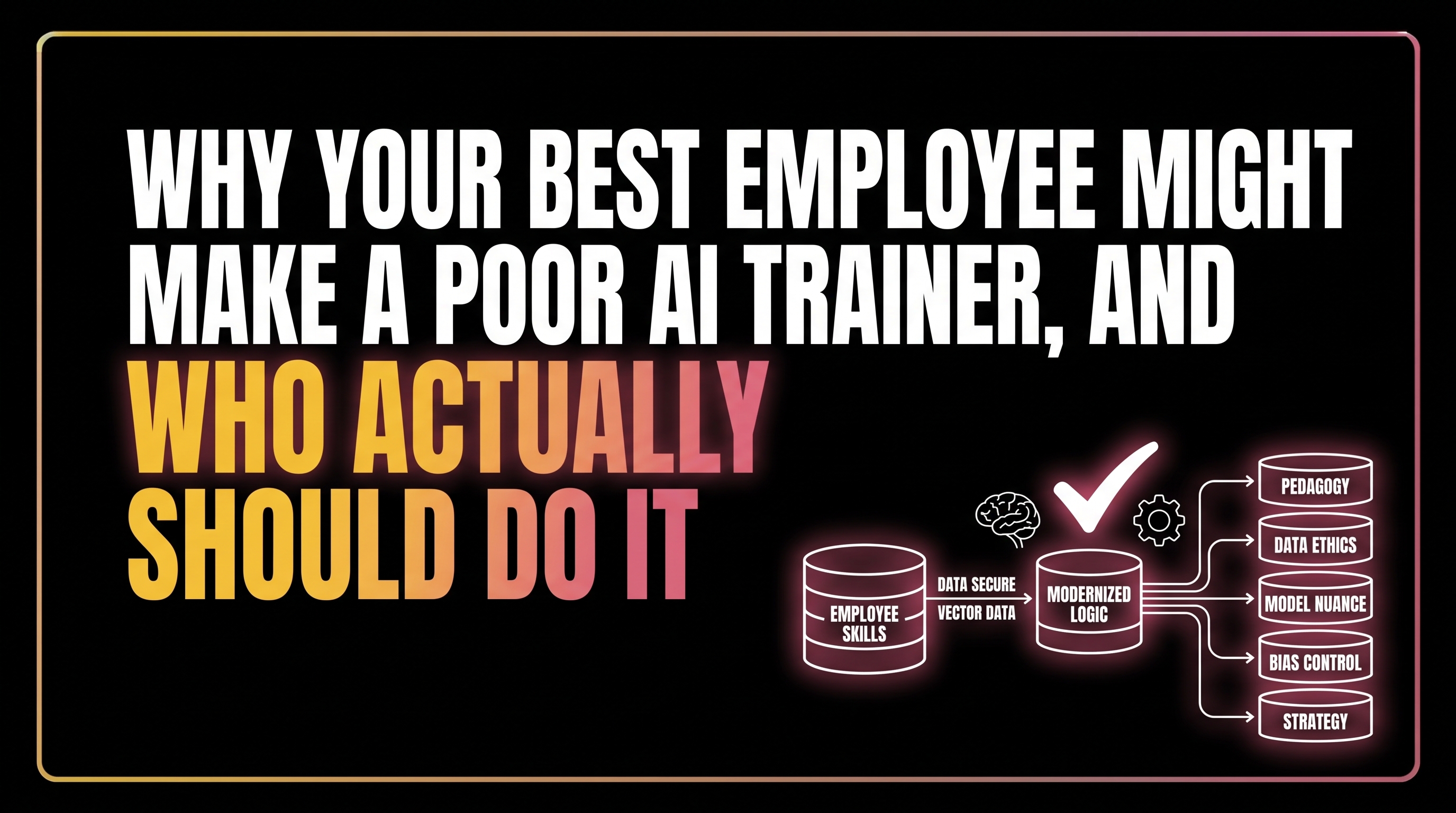
The instinct is to hand AI setup to your top performer. Here's why that's often the wrong choice, and who actually tends to do this well.
TL;DR
When a business decides to set up an AI tool, the instinctive choice is to hand the job to the team's strongest performer, the person who's clearly best at handling customers, closing deals, or whatever the tool is meant to help with. That instinct is understandable, and it's often the wrong call, for a specific, counterintuitive reason worth understanding.
A genuinely skilled performer frequently operates on intuition built up over years, judgment calls they make instantly without consciously working through the reasoning behind them. Ask that person to explain exactly why they handled a specific situation a certain way, and the honest answer is often something close to "it just felt right," rather than a specific, articulable rule. That's a real strength in the moment, and a genuine liability when the task is training a system that needs actual explicit examples and clear reasoning to learn from, not an instinct nobody can fully put into words.
An AI tool doesn't learn from watching someone perform well the way a new hire shadowing an expert might absorb things implicitly over time. It learns from what's actually provided, explicit examples, clear criteria, specific reasoning. A brilliant performer who can't articulate why they made a specific call gives the tool considerably less to actually work with than someone with slightly less raw skill but a much clearer sense of the underlying process and the ability to explain it.
The person who does this well is usually someone with strong process awareness, a genuine understanding of why decisions get made a certain way, not necessarily the single best individual performer. This is often someone who's trained other people before, since that's a related and genuinely transferable skill, translating instinct and experience into something teachable. It's also often someone with the patience to sit through a genuinely detailed setup process, since good AI training tends to be a slower, more methodical task than most day-to-day work.
A strong AI trainer can answer specific questions clearly:
If someone's answer to those questions is consistently some version of "you just know it when you see it," that's a meaningful signal they may not be the right person for this specific task, regardless of how good they are at the underlying job itself.
The skill of doing a job well and the skill of articulating exactly why you do it that way are genuinely different skills, and assuming they always come packaged together in the same person is a common, avoidable mistake in AI setup specifically.
Recognizing this distinction upfront can save a business from a genuinely disappointing setup process, where the obvious choice of "our best person" turns out to produce a vaguer, less useful training foundation than a more process-oriented team member would have. It's worth explicitly asking, before assigning this task, not just "who's best at this job" but "who can actually explain, in specific detail, why the best approach is the best approach."
If you're thinking through who on your team should actually own setting up an AI tool, that's worth a direct conversation about what the process actually requires. SalesAPE offers a free demo if you'd like to see what a real setup process looks like, no pressure either way.
Not necessarily. Top performers often rely on intuition they've never had to fully articulate, which can make it genuinely difficult for them to provide the specific, explicit examples and reasoning an AI tool actually needs to learn from effectively.
Strong process awareness, the ability to clearly explain the reasoning behind specific decisions, and patience for a detailed, methodical setup process tend to matter more than being the single best individual performer at the underlying job.
Ask them to explain, in specific detail, why they handle particular situations a certain way. If the answer is consistently vague, something like "you just know it," that's a signal they may struggle to provide the explicit examples an AI tool actually needs.
Not necessarily excluded entirely, their expertise is genuinely valuable as a source of real examples. But someone else with stronger process articulation skills may be better suited to actually lead the training process and translate that expertise into something the tool can learn from.