.svg)
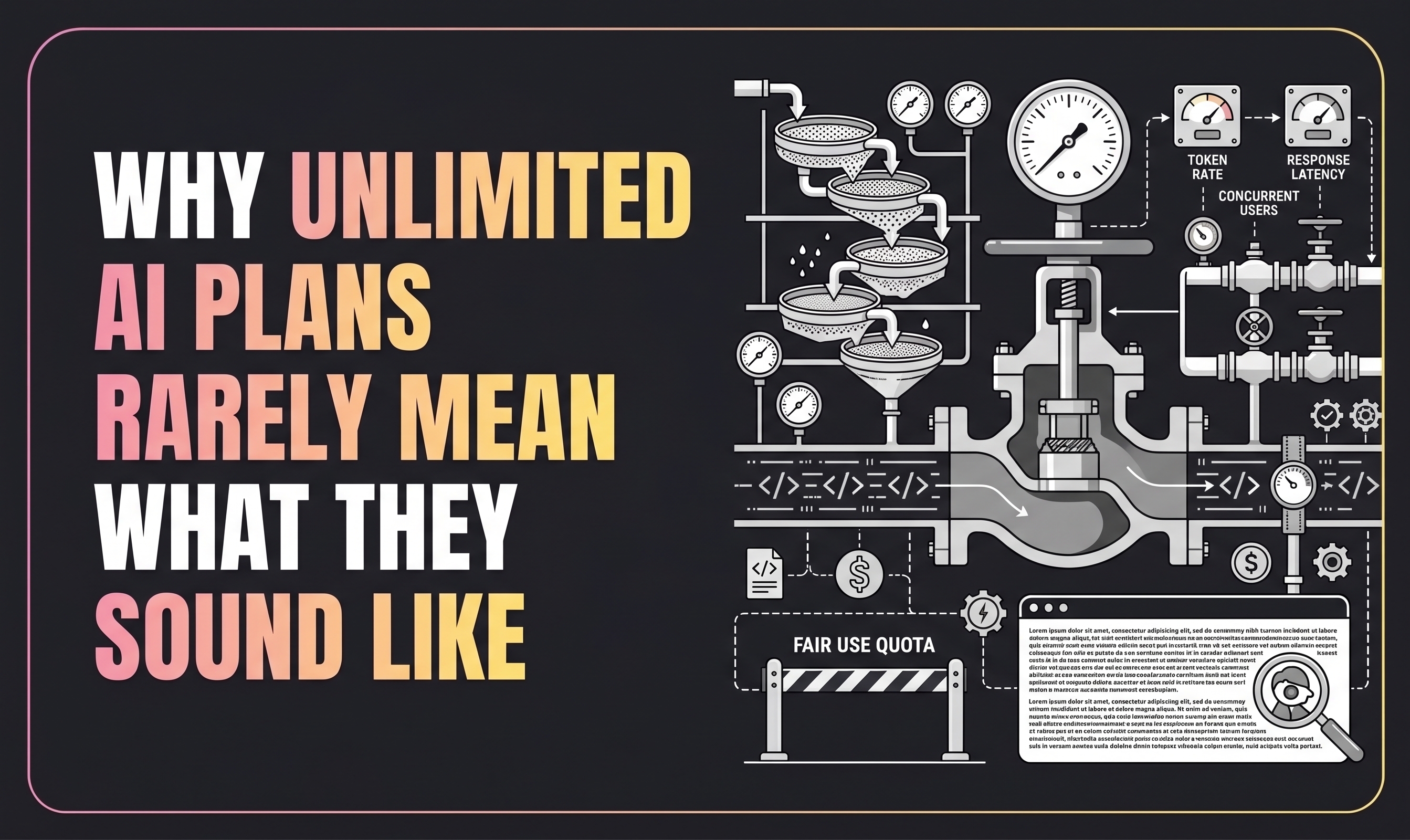
"Unlimited" on a pricing page almost always has a catch somewhere. Here's what the word actually tends to mean in practice, and what to check for.
TL;DR
"Unlimited" is one of the more consistently misleading words in software pricing generally, and AI tools follow the same well-established pattern. The word sounds like a straightforward, generous promise. In practice, it almost always has some kind of boundary attached that isn't obvious from the word itself.
Providing genuinely unlimited use of any resource, computing capacity, staff time, underlying infrastructure, has a real, underlying cost that doesn't disappear just because a pricing page uses the word "unlimited." Vendors offering an "unlimited" plan are almost always managing that real cost somewhere, through a fair-use policy, a technical rate limit, or a narrower definition of what's actually included than the plain meaning of the word implies.
A plan advertised as unlimited on the pricing page often has a separate fair-use policy in the terms of service defining a practical cap on what "unlimited" actually means, sometimes only enforced if usage significantly exceeds what's considered reasonable, but a real limit nonetheless, worth knowing about before you're the account that triggers it.
Rather than a hard usage cap, some "unlimited" plans instead impose a rate limit, a maximum number of requests or interactions allowed within a specific time window, which functionally behaves like a limit even though the plan itself is never described using that word.
Sometimes "unlimited" genuinely applies to one specific part of the service, unlimited users, for instance, while usage volume, message count, or a different dimension entirely still carries a real, separate limit. The word is technically accurate about the one thing it's actually describing, while implying something considerably broader.
Since "unlimited" in software pricing almost universally comes with some kind of practical boundary, the useful move isn't avoiding vendors who use the word, it's asking specifically what happens at high usage volumes and getting a concrete, specific answer rather than accepting the word itself as a complete description of what you're actually getting.
A vendor with a genuinely reasonable, well-explained fair-use policy generally has no issue describing it specifically when asked directly. Hesitation or vagueness in response to a direct question about what "unlimited" actually means in practice is itself a meaningful signal, worth paying attention to regardless of how confidently the word appears on the pricing page.
If you want a clear, specific answer about what a plan actually includes rather than a word that sounds generous but isn't fully explained, that's worth asking about directly. SalesAPE offers a free demo if you'd like to talk through pricing specifics, no pressure either way.
Almost never in practice. The word typically comes with some kind of boundary attached, a fair-use policy, a technical rate limit, or a narrower definition of what's actually included, even though the pricing page itself doesn't spell that out.
Check the vendor's terms of service specifically for a fair-use policy, and ask directly what happens at high usage volumes. A vendor with a reasonable policy should be able to explain it specifically rather than deflecting the question.
Yes, this is worth treating as a meaningful signal. A vendor confident in a reasonable, well-designed policy generally has no issue explaining it specifically when asked directly, rather than staying vague about what the word actually covers.
Ask specifically what happens at genuinely high usage volumes, whether there's a fair-use policy, a rate limit, or any practical boundary not obvious from the word "unlimited" itself, and get a concrete, specific answer rather than a general reassurance.