.svg)
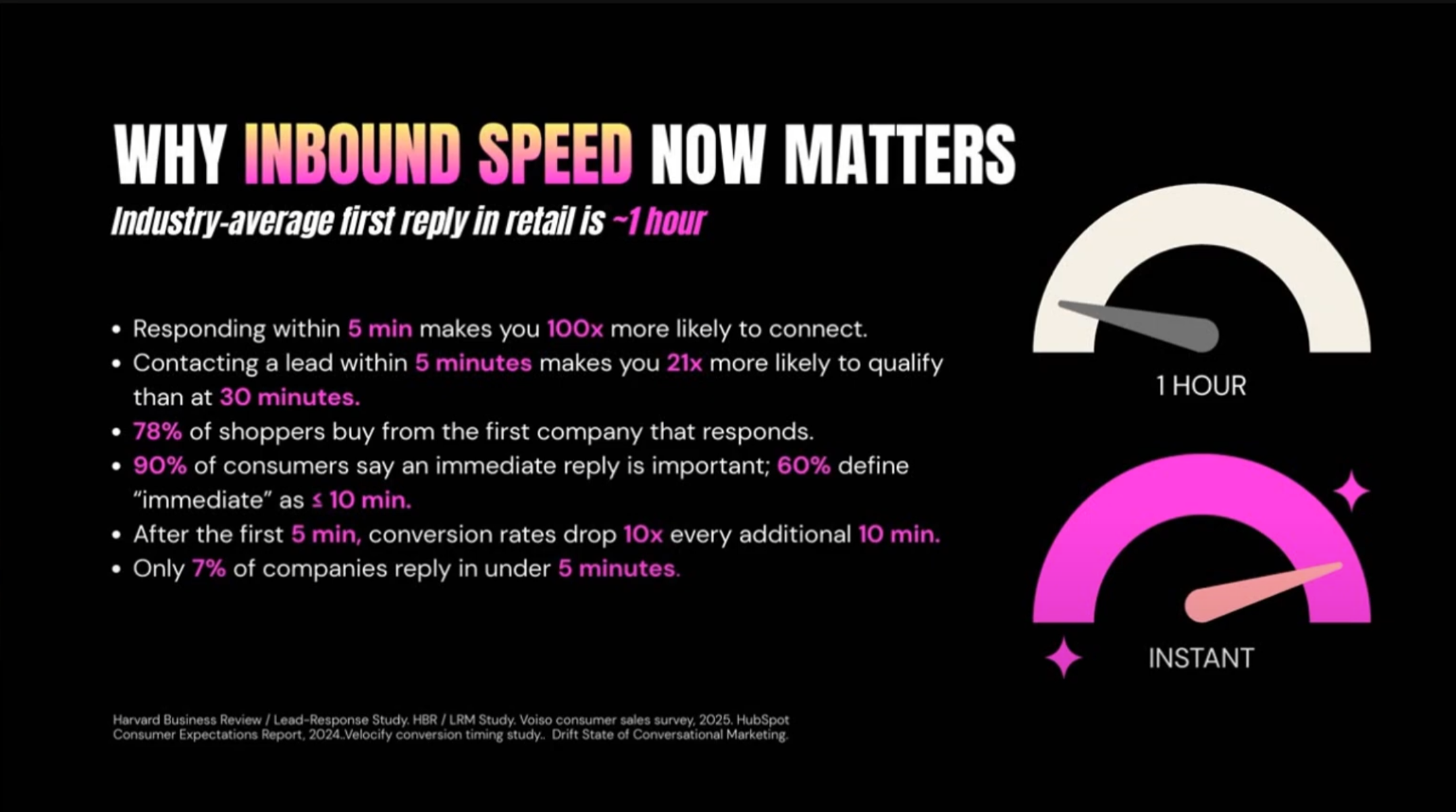
Discover why speed to lead is crucial for boosting revenue. Learn how responding to inbound leads within five minutes can make you 100 times more likely to connect with them and why 78% of shoppers buy from the first company to respond.
In our last article, we introduced you to our deep dive on inbound sales in our webinar How To Use AI To Make Sure You Never Miss An Inbound Lead Again. If you missed it or you just want to refresh your memory, you can check it out here.
In this article we’re going to carry on covering the topics Dom and Frank discussed in our webinar. Now, we're getting into the most critical topic: speed to lead. If you're a sales leader, operations manager, or even a founder, this is the single most impactful thing you can do to boost your revenue.
Don't just take our word for it. The data is crystal clear: responding to an inbound lead within five minutes makes you 100 times more likely to connect with them. That's not a typo. And it's not just a B2B metric. As Dom shared, when he was looking for contractors to fix up his house, the ones who got his business were always the first or second ones to respond. It’s simple human behavior—whoever gets there first wins.
In today's fast-paced world, buyers have endless options. Your competitors are only a Google search away. Frank mentioned that in his past life, his sales team had an SLA of five minutes to call leads, and they even had reps working 24/7. That's because he knew their buyers were savvy and would look for alternatives. When you're super fast, you're not just providing a service; you're building trust.
Think about it from your customer's perspective. When they get an immediate response, it signals that you're an efficient, reliable business. This is true for a B2C customer looking for a quick fix on their house and for a B2B buyer on your website who needs software right now. We're living in an Amazon Prime world. People want immediate gratification, whether it’s a new gadget or a software demo. If you're not available to book a meeting today, you're likely losing that lead.
As a sidenote. If you’re reading this thinking you’d really like to see a demo of a super quick AI Sales Agent - check out our SalesApe AI demo now…
The faster you are, the more you can capitalize on impulse buying. As Frank and Dom joked, sometimes a person might want to buy a high-ticket item, but 30 minutes later, the impulse is gone. This happens in both the B2C and B2B worlds. If you're quick, you can capture that momentum and push the lead down the funnel before they have a chance to reconsider or check out your competitors.
Here's an even better stat: 78% of shoppers buy from the first company that responds. The competition is already tough, and in a "red ocean" market with many competitors, speed isn't a strategy—it's a requirement.
So, how fast are you? Do you have an SLA for inbound leads? If you don't, you could be losing a massive amount of potential revenue. In our next article, we’ll dive into the common bottlenecks that prevent businesses from achieving this speed, and how new technology is helping to solve this age-old problem.
Data shows that responding to an inbound lead within five minutes makes a company 100 times more likely to connect with the prospect compared to waiting 30 minutes. This window is critical because it captures the lead while they are still focused on their problem and actively looking for a solution. Once that window closes, the lead often moves on to a competitor or loses the initial impulse to buy.
In a fast-paced digital economy, speed is equated with reliability. When a business responds almost instantly, it signals to the customer that the company is efficient, well-organized, and values their time. Whether it is a homeowner looking for a contractor or a B2B executive seeking software, a quick reply builds immediate rapport and sets a professional tone for the rest of the relationship.
The impact is massive: approximately 78% of shoppers buy from the first company that responds to their inquiry. In a red ocean market where multiple businesses offer similar services, being the first to engage often matters more than having the lowest price. Whoever reaches the customer first effectively sets the criteria for the purchase and closes the door on the competition.
Yes. While B2B sales cycles are typically longer and more complex, the initial point of contact is still driven by human behavior. B2B buyers expect the same immediate gratification they experience in their personal lives. If a high-level lead is ready to book a demo or ask a technical question, failing to provide an instant response can cause them to lose momentum or begin a conversation with a more responsive competitor.
Maintaining a sub-five-minute Service Level Agreement (SLA) around the clock is nearly impossible with a human-only team due to sleep, breaks, and time zone differences. This is where AI sales agents become essential. An AI agent can provide a sub-60-second response at any time of day or night, ensuring that the five-minute gold standard is met 100% of the time without the overhead of a massive global support team.