.svg)
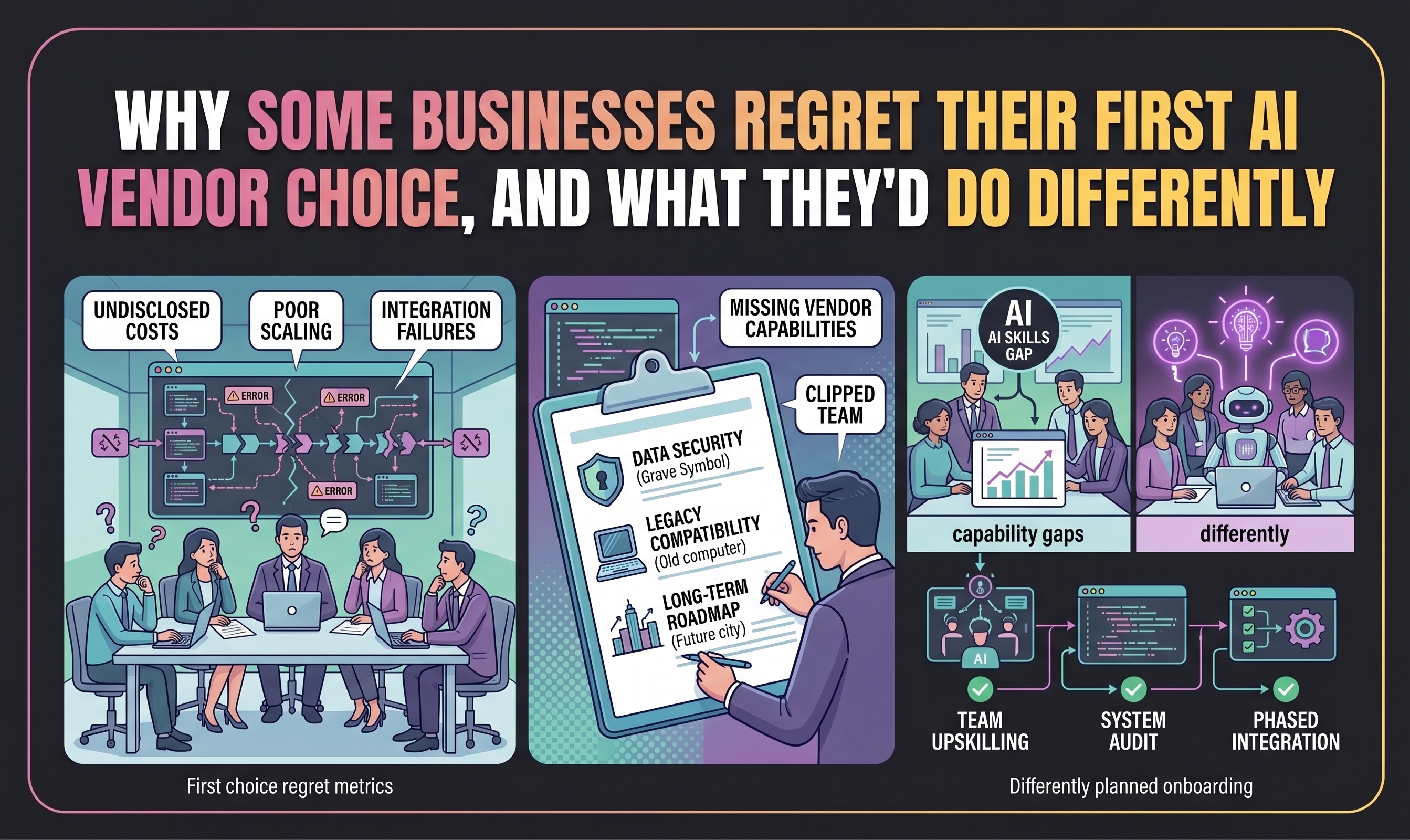
A first AI vendor choice often gets revisited within a year. Here's what businesses commonly say, in hindsight, they'd actually do differently.
TL;DR
A first AI vendor choice often gets revisited sooner than expected, sometimes within the first year. The underlying regret usually isn't really about AI failing to deliver on its promise broadly, it's about a handful of specific, recurring decisions in how that first choice actually got made.
A polished, impressive demonstration is a genuinely poor predictor of long-term fit, since a demo is, by design, showing a curated best case rather than how a tool handles the specific, messy reality of your actual business. Businesses commonly report that the vendor with the flashiest demo wasn't the one that ended up serving them best over time.
Rushing to select a vendor, sometimes under real internal pressure to "just get something in place," tends to mean skipping the more careful questions about setup process, ongoing support, and actual fit that only become obvious once the tool is genuinely being used, by which point switching feels like a bigger disruption than the original choice ever did.
A vendor's marketing often understates the real time and effort setup actually takes, and businesses commonly report being surprised by how much more involved the process turned out to be than initially expected, leading to a rushed, incomplete setup that produced disappointing early results the business then attributed to the tool itself rather than the truncated process.
A tool that fit well at the business's original size and complexity sometimes turns out to be considerably harder to adapt as the business changed, a gap businesses commonly say they wish they'd specifically probed during the original evaluation, rather than assuming initial fit would simply hold indefinitely.
Price is a real, legitimate factor, but businesses commonly report that choosing primarily on the lowest price meant getting meaningfully less support, flexibility, or capability than a slightly more expensive option would have provided, a tradeoff that became clear only well after the decision was already made.
The recurring regret across most of these stories isn't about AI as a technology falling short, it's about specific, avoidable gaps in the original evaluation process, exactly the kind of gaps a slightly more deliberate first evaluation would have caught.
None of this means a first vendor choice needs to be perfect or exhaustively researched to avoid regret later. It means specifically probing the areas that most commonly turn out to matter later, actual fit beyond the demo, realistic setup effort, long-term flexibility, what's genuinely included versus what's not, rather than optimizing primarily for the most impressive pitch or the lowest sticker price.
If you want to evaluate an AI tool against the specific questions that actually predict long-term fit, rather than just the initial pitch, that's worth a direct conversation. SalesAPE offers a free demo if you'd like to talk through it, no pressure either way.
Usually not because AI itself failed to deliver, but because of specific, recurring gaps in the original evaluation process: choosing based on the most impressive demo, moving too fast, underestimating setup effort, or not probing long-term flexibility upfront.
Not automatically, but businesses commonly report that choosing primarily on price meant getting meaningfully less support or flexibility than a slightly more expensive option would have provided, a tradeoff that often only becomes clear well after the decision is made.
By specifically probing the areas that most commonly cause regret later, actual fit beyond a polished demo, realistic setup effort, long-term flexibility as the business changes, and what's genuinely included, rather than optimizing mainly for the flashiest pitch or lowest price.
Not usually. The recurring pattern in these stories points to specific, avoidable gaps in how the original choice was evaluated, not a fundamental problem with AI as a technology or a category of investment.