.svg)
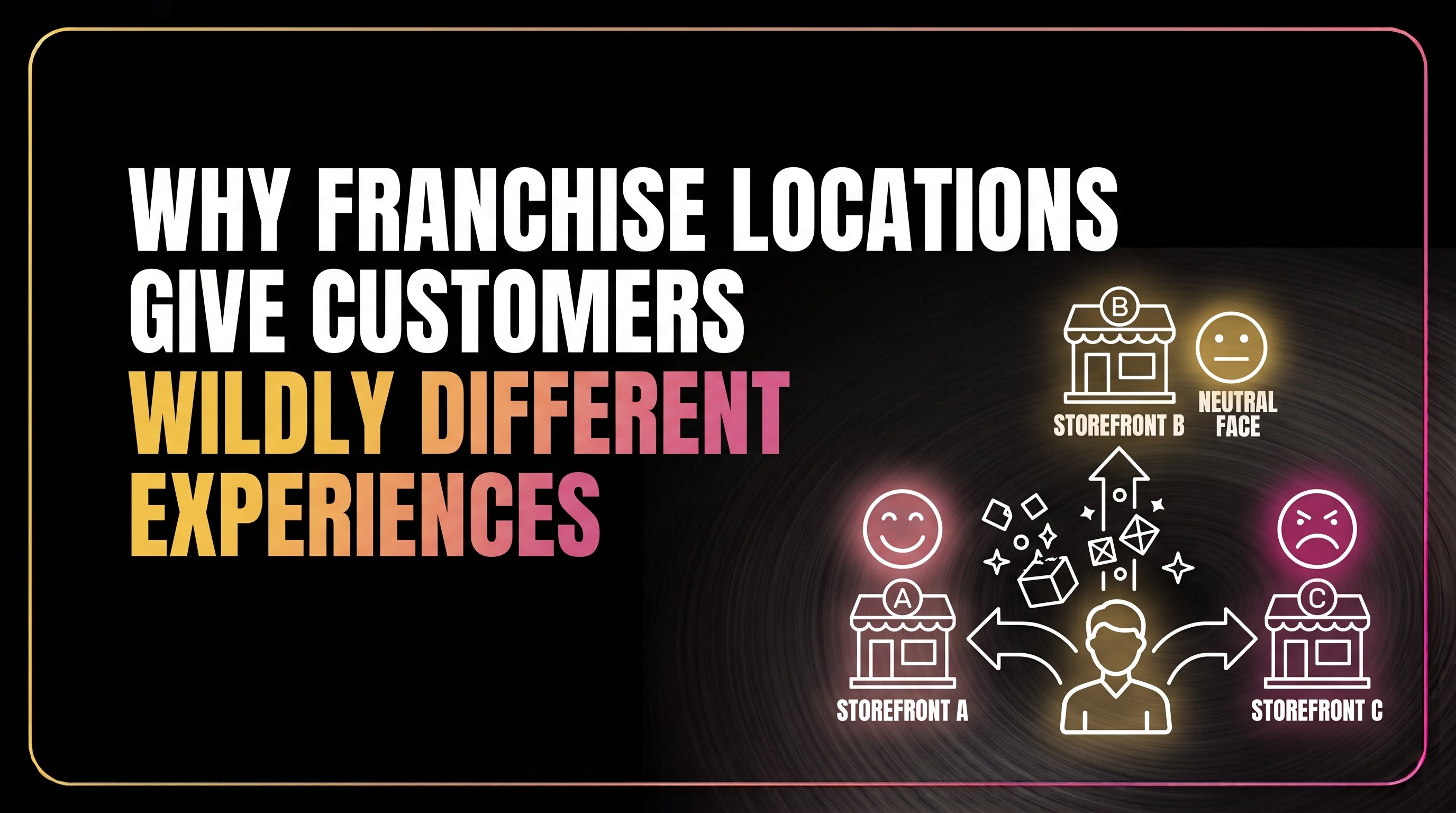
The same brand can feel completely different from one location to the next. Here's the structural reason why, and what actually closes the gap.
TL;DR
Two locations of the same franchise brand, same signage, same menu or service list, same corporate branding, can leave a customer with completely different impressions. One location answers quickly and handles the interaction smoothly. Another leaves the customer waiting, dealing with someone who clearly doesn't have the same information or training. The brand is identical. The experience isn't.
It's tempting to explain this gap as one franchisee simply running a tighter operation than another, and sometimes that's part of it. But the more structural explanation is that franchise brand standards typically cover the visible, static parts of the experience, signage, menu, uniform, core service offering, while leaving a lot of the actual day-to-day operational experience, how quickly inquiries get answered, how consistently staff apply judgment calls, what tools are actually used to manage customer interactions, up to each individual location.
One location might have an experienced, well-trained team that's been there for years. Another might be dealing with high turnover and staff who are still learning the role. Brand standards don't control staffing quality or turnover directly, and that variable alone accounts for a meaningful share of the experience gap between locations.
Even when a franchise provides recommended systems, individual locations frequently adopt their own workarounds, whichever phone system, scheduling tool, or customer communication process a particular franchisee happened to set up. Two locations can be technically operating under the same brand while running functionally different back-end processes for handling the exact same type of customer interaction.
A lot of customer-facing decisions, how to handle an unusual request, how to prioritize a busy moment, how flexible to be on an edge case, come down to individual judgment in the moment. Without a shared, consistent way of capturing and applying that judgment across locations, each location effectively develops its own informal standard over time, even while operating under identical formal brand guidelines.
A customer doesn't experience "the brand" in the abstract, they experience one specific location, and an inconsistent experience across locations quietly undermines the trust a consistent brand identity is supposed to build in the first place.
A customer who has one bad experience at any location tends to generalize that impression to the brand as a whole, regardless of how well other locations perform. That makes the inconsistency a genuine brand risk, not just a minor operational quirk isolated to one underperforming site.
Closing this gap isn't primarily about tighter enforcement of visible brand standards, which already tend to be fairly consistent across locations. It's about the parts underneath those standards: making sure every location has consistent access to the same quality of tools and captured knowledge for handling customer interactions, not just the same signage and menu. A shared, centrally maintained approach to things like inbound response and customer communication, applied consistently across every location rather than left to individual setup, addresses the actual source of the gap rather than the visible symptoms of it.
Why do different locations of the same franchise feel so different to customers?Mostly because franchise brand standards typically cover visible elements like signage and menu, while operational details, staffing quality, local tools, and day-to-day judgment calls, are often left up to each individual location, creating real variation beneath a consistent surface.
Is franchise inconsistency mainly a training problem?Training is part of it, but not the whole picture. Local staffing turnover, differing tools and processes between locations, and inconsistent judgment calls all contribute independently, even at locations with genuinely well-trained staff.
Does one bad location actually affect the whole brand's reputation?Often, yes. Customers tend to generalize a single experience to their overall impression of the brand, regardless of how other locations perform, which makes cross-location consistency a real brand risk rather than an isolated operational issue.
What actually helps make franchise locations more consistent?Standardizing the operational layer underneath the visible brand standards, particularly tools and processes for handling customer interactions, tends to matter more than reinforcing visible standards that are usually already fairly consistent across locations.