.svg)
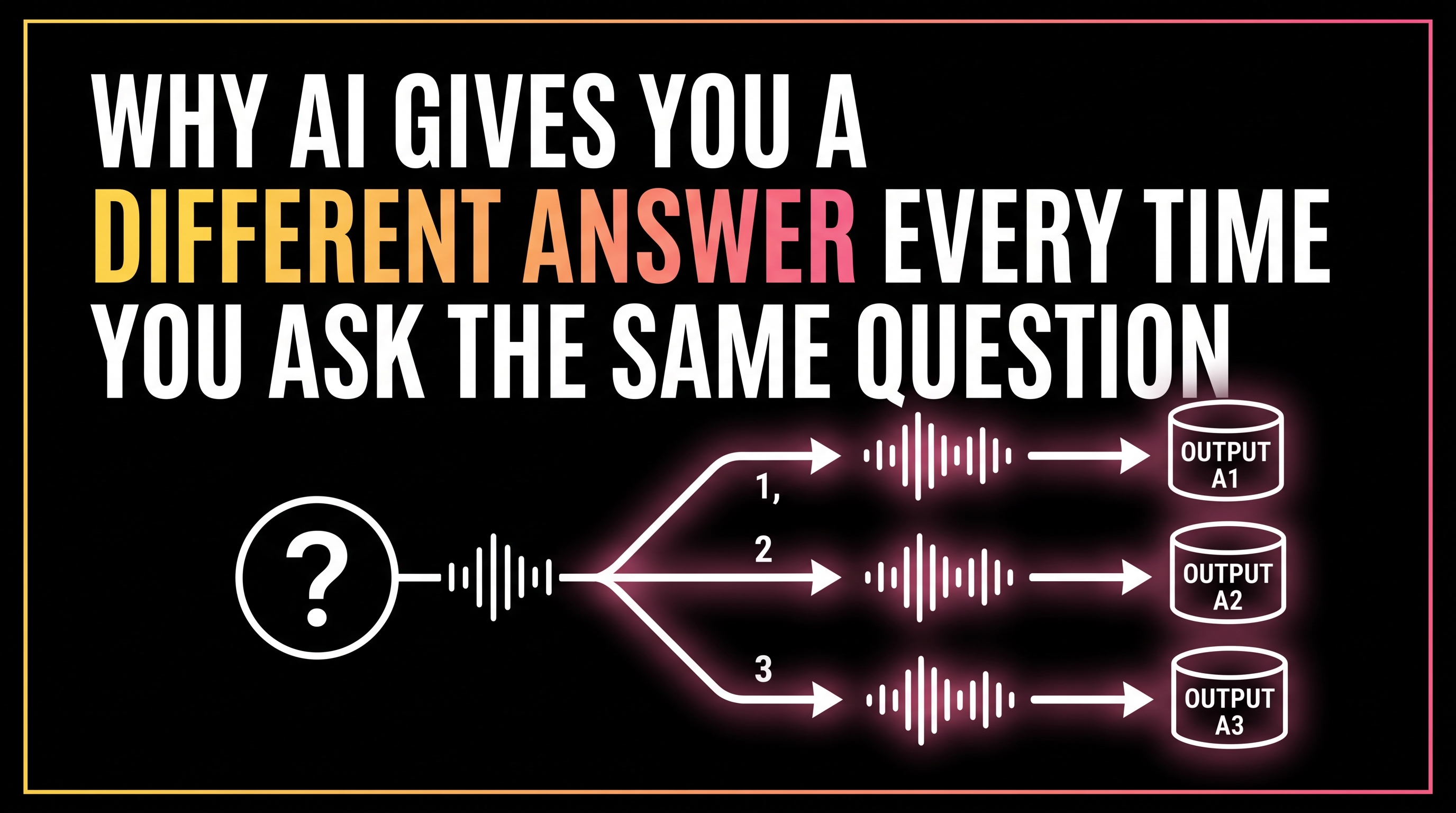
Ask an AI the same question twice and you'll often get two different answers. Here's the actual reason, and it's not a bug.
TL;DR
Type the exact same question into an AI chat twice in a row, and you might get two different answers. Not necessarily contradictory, but different enough in wording, structure, or even conclusion to be noticeable. This surprises a lot of people who expect a computer program to behave the same way every time given the same input. Here's why that expectation doesn't quite hold for this particular kind of technology.
Most software is deterministic: the same input reliably produces the same output, that's actually a basic expectation of how computers work. AI language models break that expectation on purpose. At each step of generating a response, the model isn't picking the single most likely next word every time, it's sampling from a range of statistically plausible options, with some controlled randomness built into that selection. Run the same prompt through that process twice, and the small random choices at each step can compound into a noticeably different final response.
It might seem like this randomness should simply be removed to make responses consistent, but it's actually there for a good reason. Without it, a model would always generate the single most statistically predictable response to any given prompt, which tends to produce flatter, more repetitive, less useful output.
The controlled randomness is part of what makes responses feel varied and natural rather than robotically identical every time, it's a deliberate design tradeoff, not an oversight.
If you ask the same question twice and get two answers that say essentially the same thing in different words, that's expected behavior, not a sign anything went wrong. The underlying facts or reasoning are often consistent even when the specific phrasing varies.
If two attempts at the same question produce genuinely different conclusions, not just different wording, but different facts or different recommendations, that's a more meaningful signal. It suggests the question sits in an area where the model doesn't have a strong, consistent basis for its answer, which is worth treating as a flag to verify independently rather than trusting either answer at face value.
For a creative writing prompt, this variability is often a genuine benefit, nobody wants the exact same poem generated every time. For a factual question with one correct answer, that same variability is a real limitation worth being aware of, since it means a single response isn't necessarily the most reliable or complete version of what the model "knows."
The practical takeaway isn't that AI is unreliable, it's that a single response to a factual question is one sample from a range of possible outputs, not necessarily the definitive, most accurate version available.
For anything where the specific answer genuinely matters, asking the same question more than once, or asking it slightly differently, and comparing the results is a reasonable way to get a better sense of how confident or consistent the underlying answer actually is. Consistent answers across multiple attempts are a reasonably good sign. Answers that vary significantly are a sign worth paying attention to, not ignoring.
Yes, this is expected behavior rather than a malfunction. AI language models generate responses using controlled randomness at each step, which means the exact same input can produce noticeably different output across separate attempts.
Because the randomness serves a real purpose. Without it, models tend to produce flatter, more repetitive, less naturally varied responses. The tradeoff between consistency and natural-sounding variation is a deliberate design choice, not an unintended side effect.
Not exactly, but it does mean a single response to a factual question shouldn't automatically be treated as the definitive answer. Asking the same question more than once and comparing the results is a reasonable way to gauge how consistent or reliable a given answer actually is.
It matters more for factual questions with one correct answer than for creative tasks, where variation between attempts is often genuinely useful rather than a limitation. The same underlying behavior has different implications depending on what you're actually using it for.