.svg)
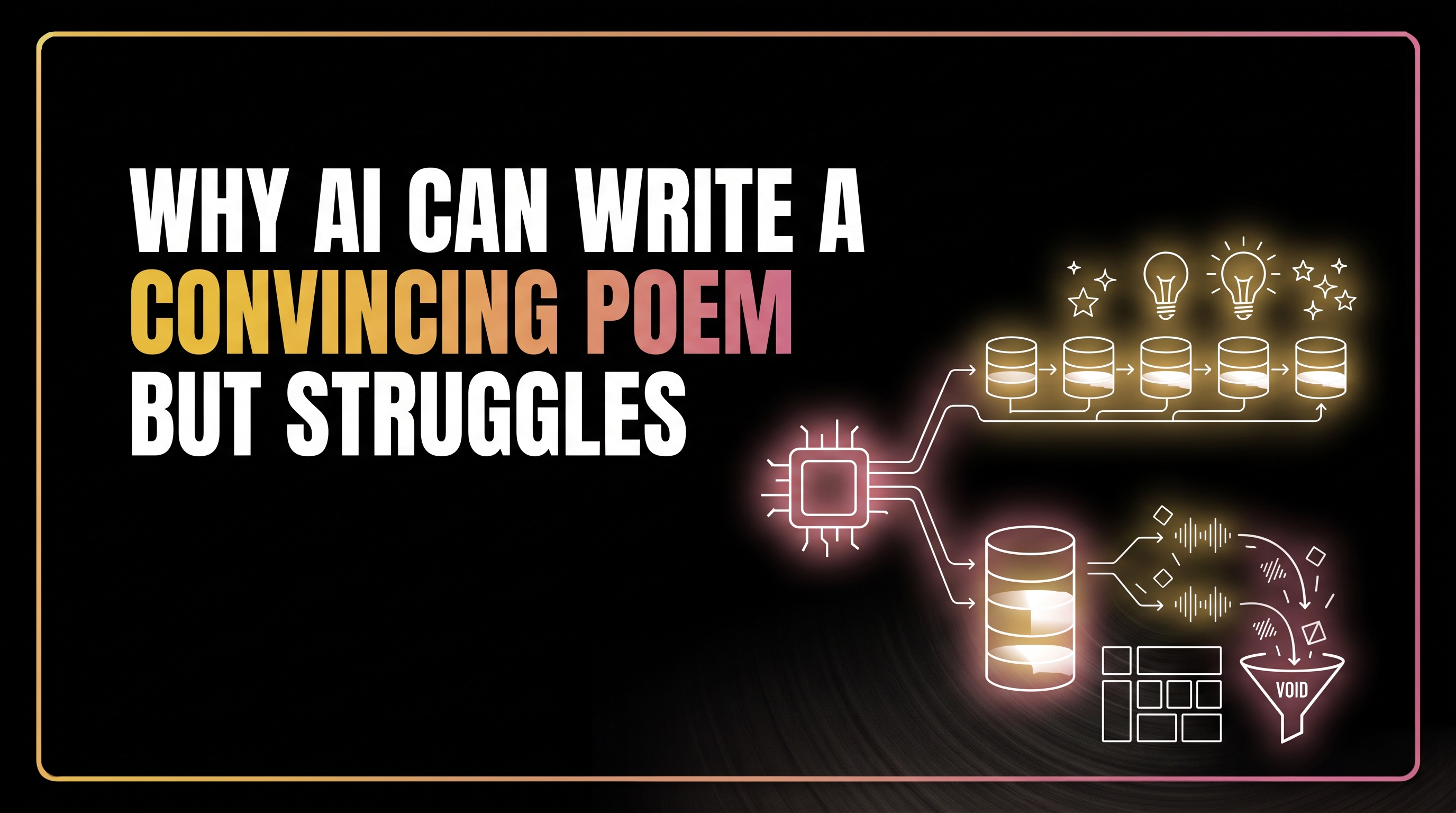
AI can write fluent poetry but often fumbles a simple crossword clue. Here's the genuinely interesting reason for the gap.
TL;DR
Ask an AI model to write a poem about autumn in the style of a specific poet, and it can produce something genuinely impressive, matching rhythm, tone, and structure convincingly. Ask the same model to solve a moderately tricky crossword clue, and it can fumble something a person would work out in seconds. This isn't a random quirk. It reflects a real, useful distinction between two very different kinds of tasks.
Writing a poem is fundamentally a fluent generation task: producing text that follows learned patterns of rhythm, word choice, and structure, drawing on an enormous amount of poetry the model has effectively absorbed patterns from during training. There's no single "correct" answer being checked against, just a wide range of outputs that can all be reasonably good. This is close to the exact thing these models are built to do well, generating fluent, pattern-consistent text.
A crossword clue usually has exactly one correct answer, constrained by both meaning and letter count, sometimes involving wordplay, puns, or double meanings that require precise, exact reasoning rather than fluent pattern generation. Getting it right isn't about producing something plausible, it's about landing on the one specific correct answer that satisfies multiple exact constraints simultaneously. That's a meaningfully different kind of task than generating fluent text, and it's one current AI models handle far less reliably.
AI is good at:
AI struggles with:
Even though both categories might seem, on the surface, like they should be comparably difficult.
Knowing that AI's strength lies specifically in fluent pattern generation, not precise constraint-solving, is a much more reliable way to predict how well it'll handle a new task than guessing based on how impressive or difficult that task seems on the surface.
This isn't just a fun trivia fact, it's a genuinely practical way to think about what to expect from AI on a task you haven't tried yet. A task that's mostly about generating good, fluent, plausible content is likely to go well. A task with one precise correct answer and hard constraints is worth double-checking rather than trusting on the first attempt, regardless of how confidently the response comes back.
Writing is a fluent generation task, producing plausible, pattern-consistent text with no single correct answer. Puzzles like crosswords require precise, exact reasoning against hard constraints, a fundamentally different kind of problem that current AI models handle far less reliably.
Tasks that reward fluent, plausible generation: writing, summarizing, brainstorming, and explaining concepts in different ways. These play to how these models actually work, generating text based on learned patterns.
Tasks requiring precise, exact answers with hard constraints, like solving a crossword clue with a specific letter count, an exact calculation, or picking one correct fact among several similar-sounding possibilities.
Consider whether the task rewards fluent, plausible generation, likely to go well, or requires one precise, exactly correct answer against hard constraints, worth double-checking rather than trusting immediately, regardless of how confident the response sounds.