.svg)
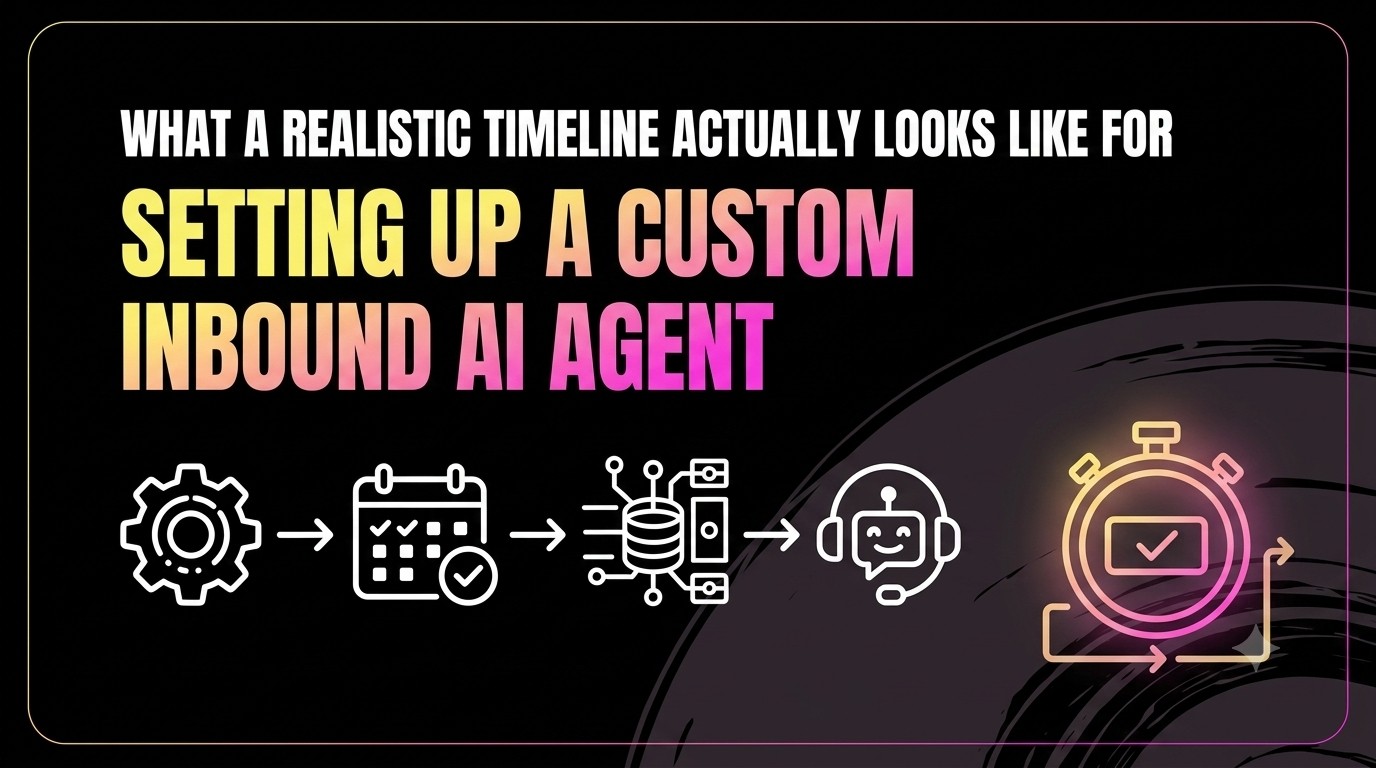
Wondering how long it actually takes to set up a custom AI agent for your business? Here's a realistic general timeline and what each phase should involve.
TL;DR
If you’re currently researching custom AI agents, you’ve probably asked this question, it’s one of the most popular questions we’re asked. It's a reasonable thing to want a real answer to, not a vague "it's quick and easy" from a sales page. A properly built setup takes real time, for good reasons, and knowing what those reasons are makes it much easier to tell a legitimate process from a rushed one.
Compare this question to wanting a new website built, a straight forward answer can’t be given until some basic information has been shared. Do you want a simple landing page or a tens of thousands of pages ecom site? Do you have an existing site you just want migrated or do you want something built from scratch? There are lots of questions that need answering because an exact time frame can be issued.
Setting operational expectations upfront matters for a simple reason: a business that expects a fully working, perfectly tuned AI agent on day one is going to be disappointed by any legitimate process, because that's not actually how good implementations work. A business that understands the real phases involved can plan around them, staff accordingly during the transition, and recognize genuine progress instead of assuming something's gone wrong when week one doesn't look like a finished product.
Before an AI agent can represent your business accurately, it needs to actually learn your business: your services, your pricing, your policies, the way your team already talks to customers. This phase usually involves structured sessions where your team provides that material directly, rather than the vendor guessing at it or pulling from generic assumptions. Skipping this step is the single biggest predictor of an agent that sounds generic or gets basic facts about your business wrong.
Once the underlying knowledge is in place, the agent needs to be configured for how you actually want conversations to run: what qualifies as a good lead for your business specifically, what information needs to be captured, when something should route to a person versus be handled automatically. This is where general knowledge about your business turns into an actual working process.
A well-built implementation gets tested against real or realistic conversation scenarios before it ever talks to an actual customer, edge cases, unusual questions, situations where it should hand off to a human rather than guess. This phase is where problems get caught and fixed before they become a customer's actual experience, and it's a phase that takes real time to do properly.
Even after testing, a responsible rollout usually starts with limited exposure, a subset of channels, a specific volume, before expanding to full deployment. This lets any remaining issues surface at a manageable scale rather than all at once, and it gives a business a chance to sanity-check real interactions before fully committing.
A reasonable general range for a typical custom AI agent implementation, covering discovery, configuration, testing, and a phased launch, is roughly four to five weeks, though the exact timing depends heavily on the complexity of the business and how much material needs to be incorporated.
This isn't a fixed universal number, a simpler setup with limited scope might move faster, and a business with many services, complex pricing, or multiple locations should reasonably expect more time, not less. What matters more than hitting an exact week count is whether a vendor can explain, specifically, what's happening during each phase and why it takes the time it does.
If a vendor's pitch is that your AI agent will be fully live, fully accurate, and completely self-service on day one with no testing period, that's worth treating as a red flag rather than a convenience. Genuine accuracy about your specific business takes real onboarding time to build, and skipping straight to "live" usually means the agent is working from generic assumptions rather than anything specific to you, exactly the outcome a careful business is trying to avoid in the first place.
If you're evaluating vendors and want to understand what a specific, phase-by-phase timeline actually looks like for a business like yours, that's a fair and reasonable thing to ask for directly. Book a demo with SalesAPE to walk through it, or reach out at hello@salesape.ai if you'd like to talk through the general process first.
A reasonable general range is roughly four to five weeks for a typical setup, covering discovery and training, configuration, testing, and a phased rollout. Exact timing varies based on how complex the business's services, pricing, and processes are.
The agent gets trained on the business's actual material, services, pricing, policies, and existing customer communication style, rather than relying on generic assumptions. This phase is critical for making sure the agent sounds like it actually understands the business rather than guessing.
Testing against real or realistic scenarios catches problems, like edge cases or situations that should be handed to a human, before they become an actual customer's experience. Skipping this phase increases the risk of the agent making mistakes in front of real customers.
It's worth being cautious about. Genuine accuracy for a specific business takes real time to build through proper training and testing. A vendor skipping straight to "live" with no onboarding or testing period is likely offering something generic rather than something genuinely tailored to your business.