.svg)
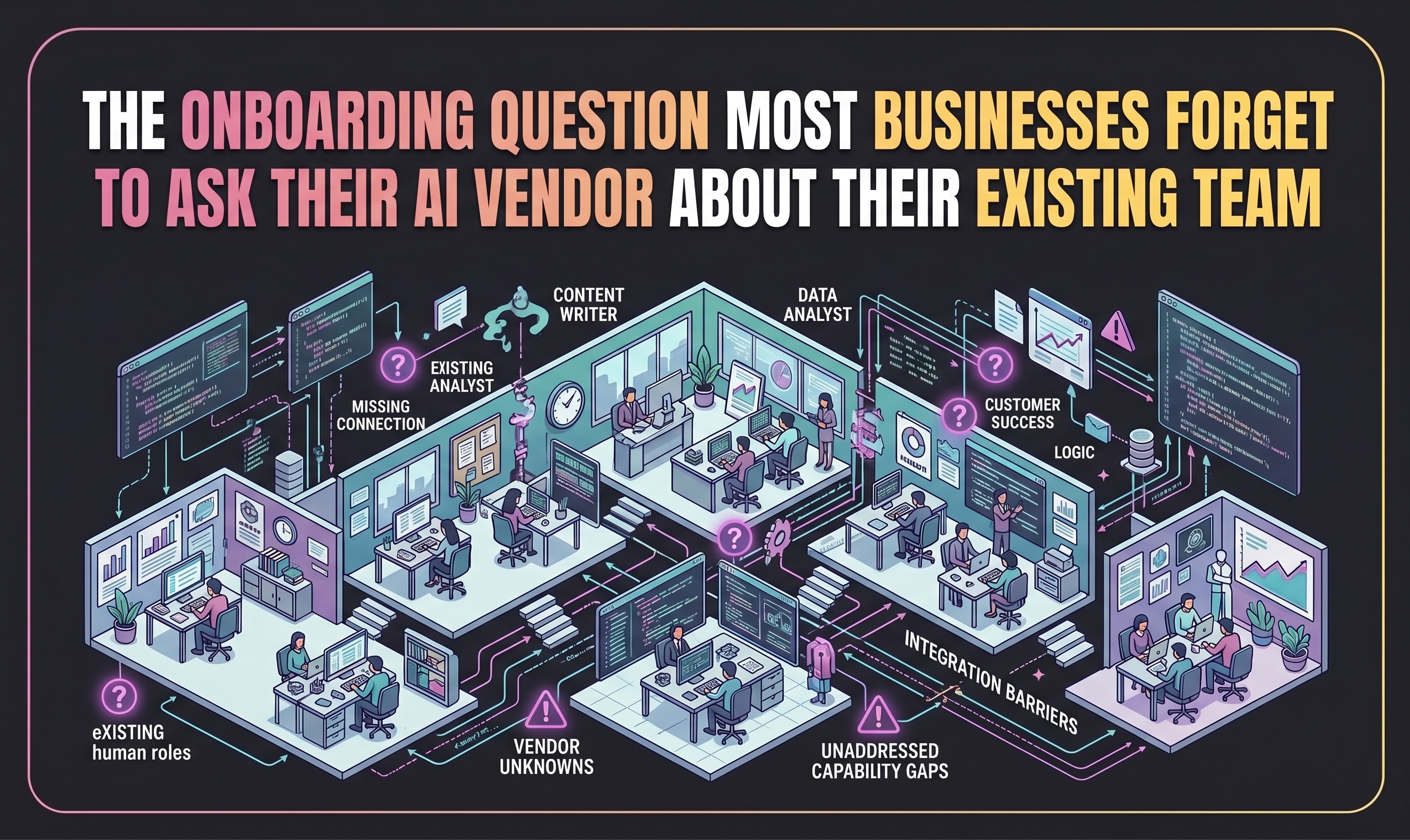
Most AI vendor evaluation focuses on the tool itself. Here's the question about your own team that gets skipped, and why it matters just as much.
TL;DR
Most AI vendor evaluation focuses heavily on the tool, what it does, how accurate it is, what it costs. A genuinely important question tends to get skipped in that process: what actually changes for the existing team, day to day, once the tool goes live. This gap is worth closing deliberately, since it affects something a lot more consequential than a smooth rollout.
Evaluating a new tool naturally centers attention on the tool itself, its capability, its accuracy, its fit for the business's needs. The team's actual day-to-day experience of working alongside that tool is a separate, less obvious question that doesn't naturally come up during a product-focused evaluation process, even though it has real, direct consequences for how smoothly the rollout actually goes.
If an AI tool takes over initial qualification or routine responses, the team members who previously handled that work need a genuinely clear answer about what they're doing instead, not just an assumption that they'll figure it out or naturally shift toward "higher value work" without any specific plan for what that actually looks like.
Whether staff are expected to review the tool's output regularly, handle specific escalations, or have minimal ongoing involvement at all is worth defining clearly before launch, rather than leaving it ambiguous and discovering the actual expectation only once real friction shows up.
If a team's role shifts because of a new AI tool, how their own performance gets evaluated afterward is worth addressing directly. A team left uncertain about how they'll be judged under a changed set of responsibilities is a genuine source of real anxiety and resistance, separate from any concern about the tool itself.
A team that experiences a new AI tool as something that happened to their job, rather than something they were genuinely prepared for with clear, specific answers, is considerably more likely to resist or work around it, regardless of how capable the underlying tool actually is.
This isn't really about managing feelings for their own sake, it's about the practical reality that a team's genuine engagement with a new process directly affects how well that process actually works in practice. A tool with real accuracy and capability can still underperform in practice if the team working alongside it wasn't given clear, specific answers about how their own role actually changes.
If you're thinking through how a new AI tool would actually integrate with your existing team's day-to-day work, that's worth a direct conversation before launch, not after. SalesAPE offers a free demo if you'd like to talk through it, no pressure either way.
Because evaluation naturally centers on the tool itself, its capability, accuracy, and cost, while the team's actual day-to-day experience is a separate question that doesn't come up automatically in a product-focused conversation.
What happens to tasks the tool now handles, how staff are expected to interact with the tool going forward, and how performance and success get measured under the changed set of responsibilities.
Yes, genuinely. A team left uncertain about how their role is changing is considerably more likely to resist or work around a new tool, regardless of how capable that tool actually is, which directly affects how well the rollout performs in practice.
Ideally, this is addressed jointly by whoever is leading the AI rollout internally and the vendor providing the tool, with clear, specific answers communicated to the affected team before launch rather than left ambiguous.