.svg)
Discover how speed-to-lead optimization converts passive website browsing into active product trials and maximizes your digital marketing ROI.
Digital marketing teams dedicate immense energy to capturing buyer attention. They optimize paid ad campaigns, refine landing page copy, design frictionless trial sign-up forms, and continuously improve organic search and AI visibility. Yet across B2B software, industrial manufacturing, and trade distribution, a silent operational bottleneck regularly undermines those efforts: delayed response times.
When a prospective customer fills out an inquiry form, requests a software demo, or asks a question via live chat, they are at the absolute peak of their buying intent. If that inquiry sits in a general sales inbox or waits for an account manager to complete a manual lead-routing process, that intent evaporates.
No matter how effective your ad targeting or landing page conversion rates are, a slow response time will systematically destroy your marketing return on investment (ROI).
The gap between a prospect submitting a form and receiving a response is where conversion rates go to die. Benchmark research on buyer response times published in the Harvard Business Review Study on Customer Contact demonstrates that organizations attempting to reach contactable leads within one hour are nearly seven times more likely to have meaningful conversations with decision-makers than those waiting even two hours.
[ Visitor Browses Site ] ──► [ Fills Out Form / Asks Question ]
│
┌─────────────────────────┴─────────────────────────┐
│ │
( Response < 60 Sec ) ( Response > 30 Min )
│ │
▼ ▼
┌───────────────────────────────────────┐ ┌───────────────────────────────────────┐
│ High Intent & Focus Intact │ │ Attention Shifts to Competitors │
│ Immediate Engagement │ │ Cold Lead / Unanswered Follow-up │
│ High Conversion to Active Trial │ │ Lost Marketing Dollars │
└───────────────────────────────────────┘ └───────────────────────────────────────┘
Furthermore, sales acceleration research detailed by Lead Response Management reveals a dramatic drop-off in contact and qualification rates as time elapses:
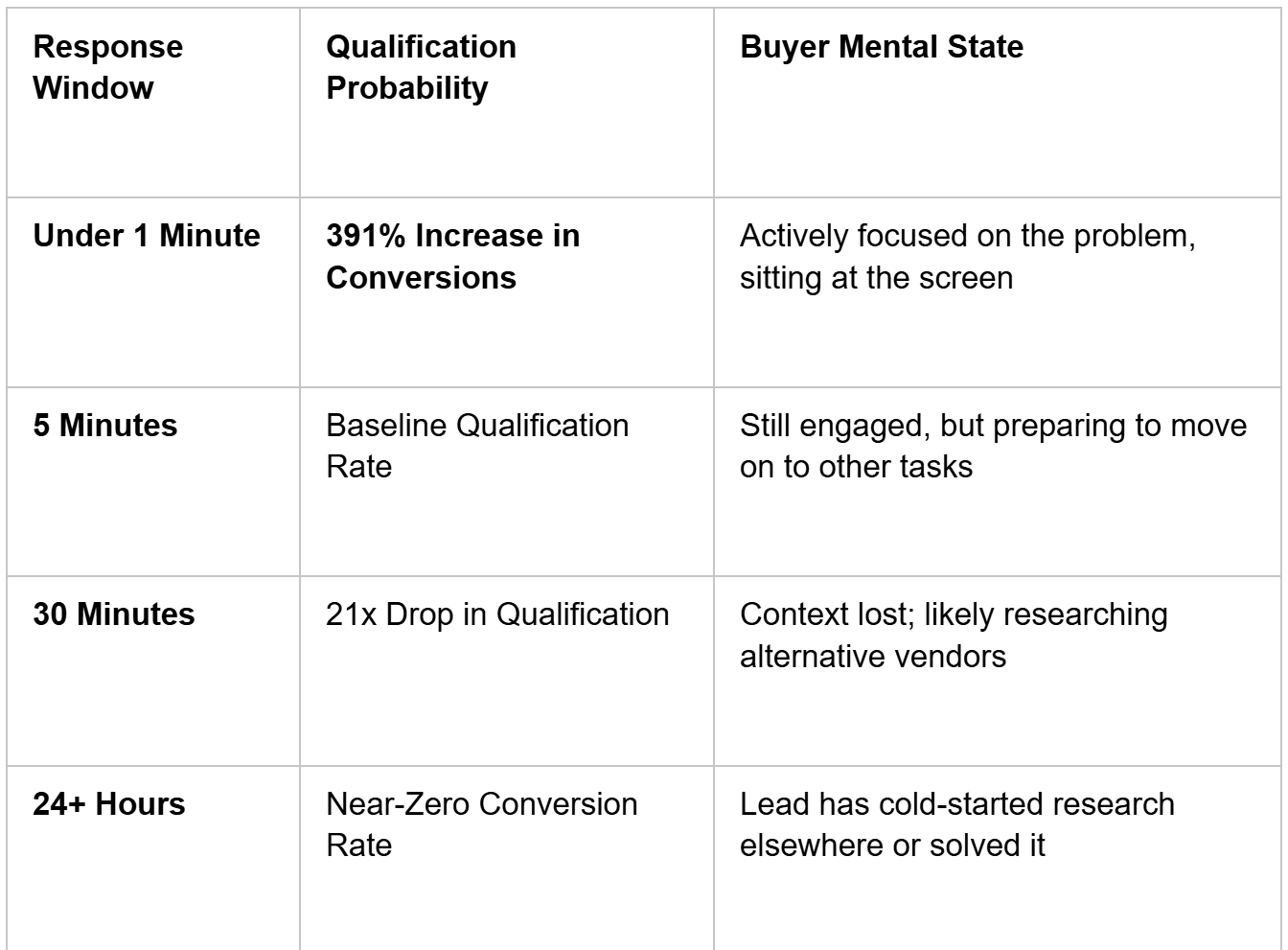
When a prospective buyer is actively researching solutions, they rarely stop at a single website. If your sales desk takes two hours to respond, your prospect has likely already engaged with a competitor who answered them in two minutes.
Most traditional sales operations were built for a world of predictable business hours and manual triage. However, today's buyers evaluate software and commercial suppliers at all hours of the day.
Relying on manual lead handling creates several structural points of failure:
If your marketing budget succeeds in getting a decision-maker to your site, failing to engage them instantly turns that paid acquisition cost into wasted ad spend.
Fixing your speed-to-lead does not require forcing your sales team to work 24/7 or hiring expensive round-the-clock call centers. Instead, forward-thinking organizations deploy an intelligent conversational intake layer directly on their digital touchpoints.
When a prospect demonstrates high intent—whether on a trial sign-up page, pricing calculator, or web chat widget—the system engages them instantly:
Optimizing your speed-to-lead is the single most effective way to multiply the value of your existing marketing spend. When inbound prospects receive helpful, accurate responses in seconds rather than hours, browse intent converts seamlessly into active product evaluations.
Eliminating response lag ensures that every dollar spent driving traffic yields maximum pipeline growth, protecting your brand's reputation and keeping prospective buyers focused squarely on your solution.
Ready to eliminate lead decay and convert high-intent website visitors into active trials instantly? You can explore a live view of our private platform through our online scheduling system or reach out directly to our integration team at hello@salesape.ai to review your lead intake workflows.
While many traditional B2B companies take hours to respond, leading digital organizations aim for a response time of under 60 seconds to engage prospects while they are still active on the website.
Intelligent intake tools can be customized with your exact ideal customer profile (ICP) rules—qualifying leads based on budget, company headcount, software environment, or region before routing them to specific sales reps.
Not when designed well. High-value buyers prioritize getting fast, accurate answers over waiting for a sales call. A direct, helpful, and non-pushy automated intake experience builds immediate credibility.