.svg)
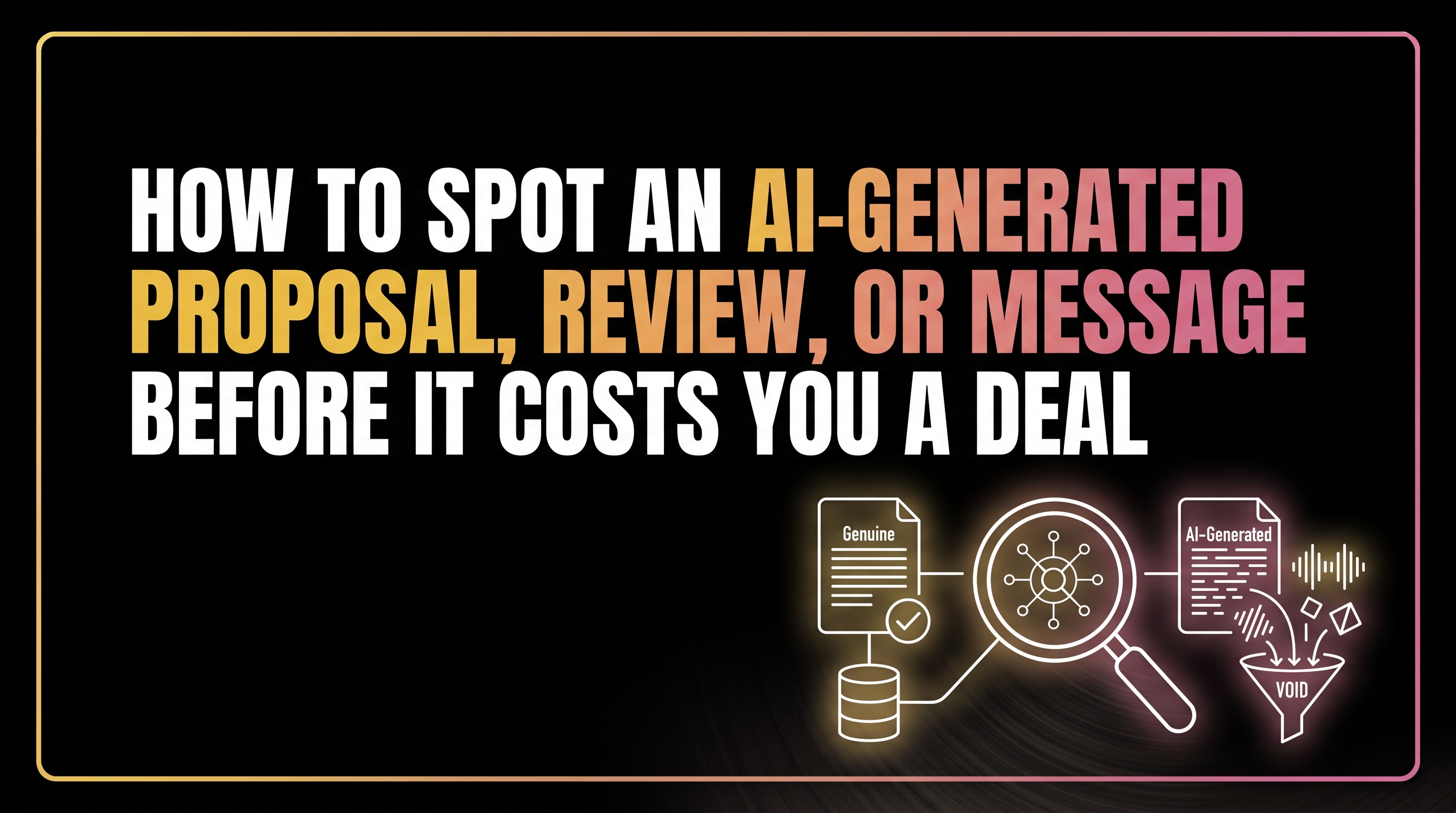
AI-generated content aimed at your business isn't always harmless. Here's how to spot a fabricated review, a scripted vendor pitch, or a scam before it costs you.
TL;DR
Most conversations about AI-generated content focus on what a business produces. It's worth paying equal attention to what a business receives, since fabricated reviews, mass-produced vendor pitches disguised as personal outreach, and outright scam messages are all increasingly built with the same tools, and increasingly harder to distinguish from something genuine.
A cluster of reviews posted in a short window, using strikingly similar phrasing or structure, praising oddly specific but generic-sounding qualities, "exceeded my expectations," "highly professional service," is worth a second look. Genuine reviews tend to be messier, more specific to an actual individual experience, and spread out over time rather than clustered.
A vendor or competitor's review profile inflated with fabricated content can genuinely mislead a real business decision, whether that's choosing a supplier or sizing up competition. Treating a suspiciously uniform run of reviews with some skepticism, and checking a platform's review history rather than trusting a single impressive score, is a reasonable precaution.
A pitch that appears personalized, using your business's name or industry, but falls apart under a specific check, generic claims about your specific situation that don't quite hold up, details that could apply to nearly any business in your sector rather than something genuinely specific to you.
Mass-produced outreach dressed up as personal attention is a long-standing sales tactic, but AI tools have made it considerably easier to produce at volume while looking more convincingly tailored than older templated approaches. Testing a pitch's specificity with one direct, pointed question about your actual situation is a quick way to see whether there's a real person who actually understands your business behind it.
Urgency paired with a request involving money, credentials, or sensitive information is the core pattern worth being alert to, regardless of how polished or well-written the message is. AI writing tools have removed a lot of the old, easy tells, awkward phrasing, obvious grammatical errors, that used to help identify scam messages at a glance.
The old advice to watch for poor grammar as a scam indicator is considerably less reliable now than it used to be. A scam message can be fluently, convincingly written and still be a scam. The actual structure of the request, urgency plus money, credentials, or sensitive access, matters more than how well it's written.
Once you look past the fluent writing quality itself, which no longer reliably distinguishes real from fabricated content, the tell tends to be in the details: reviews that are oddly uniform, pitches that fall apart under one specific question, and requests that follow the classic urgency-plus-sensitive-ask pattern regardless of how well-written they are.
The polish of the writing itself has stopped being a useful signal in any of these three cases. What still works is checking the underlying substance, does this review pattern make sense, does this pitch actually understand my specific situation, does this request follow a pattern worth being cautious about, rather than judging based on how professional something sounds on the surface.
If you want to understand how to keep your own outbound communication genuine and specific rather than falling into the same generic patterns worth being suspicious of, that's worth thinking through directly. SalesAPE offers a free demo if you'd like to see what specific, grounded communication actually looks like, no pressure either way.
Look for a cluster of reviews posted in a short window with strikingly similar phrasing, praising generic-sounding qualities rather than specific details. Genuine reviews tend to be messier, more individually specific, and spread out over time.
No, this is considerably less reliable than it used to be. AI writing tools have removed most of the obvious grammatical tells that used to help identify scam messages. The structure of the request, urgency combined with a demand for money or sensitive information, matters more than writing quality now.
Ask one specific, pointed question about your actual situation and see whether the response demonstrates real understanding or falls back on generic claims that could apply to almost any business in your sector.
Whether the underlying substance, the specific details, the request itself, actually holds up to scrutiny, rather than judging based on how professional or well-written the message sounds. Writing quality alone no longer reliably distinguishes genuine communication from fabricated or scam content.