.svg)

Learn how trade merchants keep a consistent brand voice across SMS, WhatsApp, and web chat to build customer trust and accelerate orders.
For trade merchants, building suppliers, and industrial distributors, customer relationships are built on trust, technical reliability, and clear communication. Historically, that relationship was maintained over the physical sales counter or through a direct phone call with a dedicated account manager.
As B2B buyers increasingly move to digital channels, commercial interactions have spread across multiple messaging platforms. A contractor on a job site might send a quick SMS to check stock, message a local branch on WhatsApp for delivery updates, or use live web chat on a desktop to review custom account pricing.
When these channels operate in isolated silos, the customer experience becomes fragmented. A tone that feels helpful on web chat can sound overly formal on SMS or unhelpfully brief on WhatsApp. Maintaining a single, authentic, non-technical brand voice across every messaging touchpoint is essential for building long-term trade trust and securing repeat orders.
When multi-channel messaging is handled without a unified strategy, operational disconnects quickly surface. Industry research from the McKinsey Omnichannel B2B Buyer Report indicates that corporate buyers regularly use multiple distinct channels during a single procurement journey, with consistency of service and pricing ranking as top factors in vendor retention. Furthermore, customer experience studies detailed in the Zendesk Customer Experience Trends Report highlight that disjointed brand experiences across messaging platforms directly erode buyer confidence and slow down sales cycles.
Did you know…
83% of CX leaders say that memory-rich AI agents are the key to truly personalized customer journeys.
Source
When trade distributors operate disconnected communication channels, several structural friction points emerge:
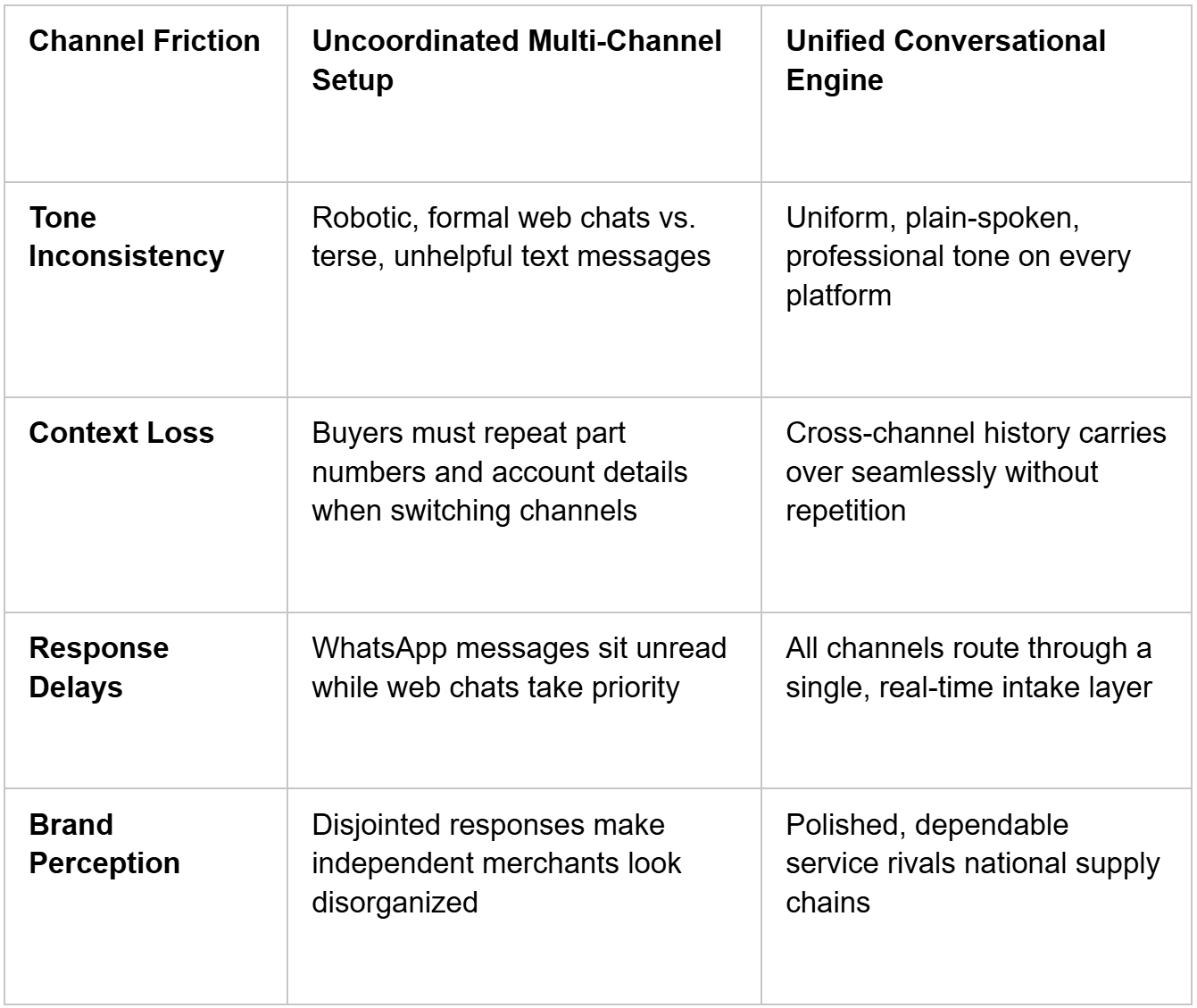
If a customer receives a warm, consultative response on WhatsApp but a rigid, automated template on web chat, your brand loses the personal touch that sets independent merchants apart from generic online competitors.
Creating a consistent brand voice does not mean using rigid corporate scripts or overly polished marketing language. For trade operators, an authentic voice is practical, conversational, and direct—focusing on solving the customer's immediate problem without unnecessary jargon.
To establish tone consistency across SMS, WhatsApp, and web chat, internal marketing and sales teams should align on three core communication principles:
While the core voice remains constant, formatting should adapt naturally to the medium. SMS demands short, direct answers. WhatsApp accommodates bulleted lists and quick image shares. Web chat allows for richer detail and direct links to spec sheets.
Avoid overly formal phrases like "Thank you for contacting our support desk; your inquiry is important to us." Instead, adopt a helpful, peer-to-peer tone: "Thanks for reaching out. Let me check that stock for you right now."
Ensure that if a buyer starts a conversation on web chat and later follows up via SMS from the field, your team or automated interface recognizes their account history and active quote requests without requiring them to start over.
Achieving true operational consistency across disparate platforms requires moving away from individual app management and deploying a centralized conversational architecture. Sitting behind your SMS lines, WhatsApp Business APIs, and website chat tools, a unified intake interface applies the same tone rules, account pricing logic, and inventory lookups across every touchpoint.
When a contractor reaches out on any platform, the system delivers an immediate, human-sounding response tailored to their specific account terms. Complex engineering queries or high-value orders are pre-qualified and handed off smoothly to senior sales reps, complete with full channel history.
Unifying your messaging channels protects your brand's reputation, streamlines daily operations for your sales desk, and ensures every customer enjoys a dependable experience no matter how they choose to connect.
Ready to unify your brand voice across SMS, WhatsApp, and web chat touchpoints? You can explore a live view of our private platform through our online scheduling system or reach out directly to our integration team at hello@salesape.ai to discuss your multi-channel messaging workflows.
WhatsApp offers instant, media-rich messaging—allowing contractors to send photos of broken parts, job site locations, or handwritten material lists directly to sales desks for immediate identification.
By grounding the underlying conversational prompts in natural, conversational trade language rather than formal corporate templates, ensuring responses sound like an experienced counter salesperson.
Yes, modern conversational intake layers connect via secure APIs to master databases, enabling real-time stock checks and account pricing updates across all messaging channels simultaneously.