Uncover the reality of AI detection in 2026. Stop relying on unreliable tools and learn the 'Digital Fingerprints' of AI writing—from 'Hallucination' to a 'Perfectly Average Tone'—and how to make your
TL;DR
AI Detection is Unreliable: Tools are increasingly inaccurate due to an "Accuracy Gap" and a bias against non-native English speakers, with OpenAI even shutting down its own low-performing detector.
Look for "Digital Fingerprints": Instead of relying on detectors, look for signs like a "Perfectly Average Tone," "Hallucination" (made-up facts/citations), and a lack of personal anecdotes or "I" and "We."
Focus on Quality, not "Undetectability": Google rewards high-quality, helpful content regardless of how it's produced. To make AI writing feel human, inject unique data, use contractions, and ensure it passes the "Vibe" check.
You’ve seen the headlines. Teachers are jumping between panic and being over-zealous, editors are on edge, and business owners are wondering if their content sounds like a robot wrote it. As for those who made their living as professional writers, they’re either worrying about proving their worth or looking at retraining.
As AI agents become your new coworkers, the big question is: How can you tell if something was written by AI like ChatGPT?
Whether you’re looking for a Turnitin alternative, trying to make your own brand voice more human or you’re just worried about being accused of something you didn’t do, here’s the reality of AI detection in 2026.
The Detection Dilemma: Can We Actually Tell?
The short answer? It’s getting harder. AI detection isn't like a spellchecker; it’s a game of probability. Most detectors look for "burstiness" (variation in sentence length) and "perplexity" (how predictable the next word is).
But here’s the catch: humans can be predictable, and AI can be programmed to be erratic.
Once you factor in the growing adoption of AI into everyday life, it becomes a moving target. The more we use AI, the more AI is being trained. The more natural it can sound and the harder it is to identify.
At the same time, we’re getting more used to using it, we’re adopting its preferred formatting into our own style of writing. It’s long been established that humans absorb text in bullet points better than long paragraphs and bolding important words helps them stand out - there’s a reason AI favours this formatting.
The Industry Stats You Need to Know:
The Accuracy Gap: Research from the University of Maryland found that current watermarking and detection techniques can be easily bypassed by paraphrasing or using "adversarial" prompts (University of Maryland, 2023).
The False Positive Problem: A study published in Patterns (Cell Press) highlighted that AI detectors have a significant bias against non-native English speakers, often flagging their human-written work as AI-generated due to simpler linguistic patterns (Patterns, 2023).
The Big Names: OpenAI (the makers of ChatGPT) actually shut down their own detection tool in late 2023 because the accuracy rate was a measly 26% (OpenAI, 2023).
How to Tell if a Paper Was Written by AI
If you’re reviewing a proposal or a report, don’t rely solely on an AI detector similar to Turnitin. Look for these "Digital Fingerprints":
Perfectly Average Tone: AI loves the middle ground. If it sounds professional but says absolutely nothing new, your "Ape Senses" should be tingling. Unless AI is writing about how great AI writing is in which case the middle ground might suddenly become more ‘pro’!
The "Hallucination" Trap: AI often makes up facts or citations with extreme confidence. Although hallucinations are getting rarer, a quick Google (or LLM of your choice) can verify quotes, data or numbers as well as links to citations.
Lack of Personal Anecdote: A robot hasn't had a bad cup of coffee or a tough sales call. If there’s zero "I" or "We," it might be a bot. I think we can all agree that this article is written by a human 😉
Looking for a Turnitin Alternative?
If you’re a business or a school looking for a way to vet content, these are the current heavy-hitters:
GPTZero: Built specifically to help educators, it’s one of the more transparent tools on the market.
Whilst it claims to have a 99% accuracy and 10million users, it also specifies results should not be used to punish or as the final verdict.
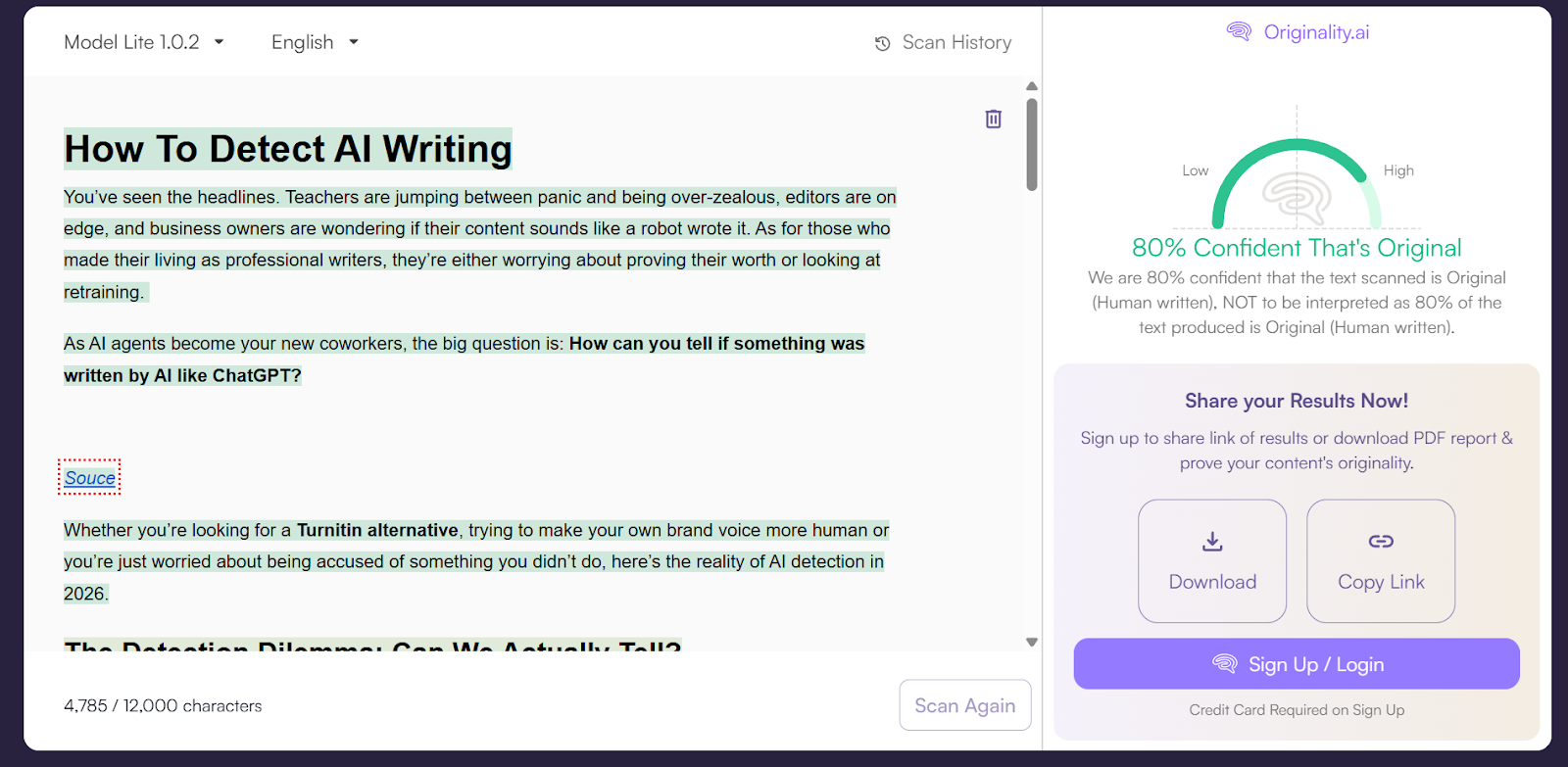
Originality.ai: Aimed at web publishers who want to ensure their SEO content stays in Google's "Helpful Content" good graces.
Also claiming to be the most accurate tool for AI-generated text detection but links to impartial studies to back this up as well as offering a free checker
Copyleaks: A robust tool that many use as a professional-grade Turnitin alternative.
Again, offers over 99% accuracy (based on internal testing), and is trusted globally to detect AI across 30+ languages and leading LLMs
If you’re using AI to help scale your content (like we do here at SalesApe), the goal isn't to "trick" people—it’s to stay helpful.
Google’s own guidance is clear: Google rewards high-quality content, however it is produced. They aren't hunting AI; they’re hunting spam (Google Search Central, 2023).
To make your writing feel human:
Inject your own data: AI can’t see your GSC reports or your proprietary sales figures.
Use contractions: Robots love "It is." Humans love "It's."
Add "Punch": Short sentences. Like this.
The "Vibe" Check: If you wouldn't say it out loud in a meeting, don't let your AI agent say it on your blog.
The SalesApe Take
At the end of the day, detection is a secondary concern. The real question is: Is this content helping your customer? Our AI agents are designed to mimic the best of human sales staff—not by being "undetectable," but by being genuinely useful, personable, and persistent. Although we often get clients telling us their AI agent is frequently mistaken for a human staff member!
Frequently Asked Questions
Q. Can I rely on an AI detector similar to Turnitin to prove plagiarism?
While tools like GPTZero or Copyleaks are helpful for flagging potential AI use, they are not foolproof. Unlike traditional plagiarism checkers that find direct matches in a database, AI detectors work on probability. Because they often flag non-native English speakers or very structured technical writing as AI-generated, these tools should be used as a starting point for a conversation rather than a definitive "verdict."
Q. Is there a Turnitin alternative that is 100% accurate?
In short: No. Even the most advanced tools, such as Originality.ai, admit that there is no such thing as a 100% accurate detector. The technology behind AI evolves faster than the tools designed to catch it. Instead of searching for a "perfect" alternative, most editors and educators now look for "digital fingerprints"—such as a lack of personal anecdotes or "hallucinated" facts—to supplement what the software finds.
Q. How to make your AI writing undetectable to Google?
The secret to "undetectable" writing isn't about using a fancy paraphraser; it’s about adding human value. Google’s algorithms prioritize helpful, high-quality content over the method of production. To ensure your content resonates with both readers and search engines, inject proprietary data, use a unique brand voice, and always fact-check AI claims. If the content is genuinely useful and sounds like your brand, its "AI score" becomes irrelevant.
.svg)