.svg)
Learn how independent machinery manufacturers use instant messaging lines to capture technical component inquiries and stop buyer drop-off.
In the custom machinery and industrial equipment sector, winning orders depends heavily on speed, technical precision, and early operational clarity. When a plant manager, maintenance engineer, or procurement director reaches out for a replacement spindle, custom gear assembly, or specialized hydraulic manifold, they rarely have time to wait for a sluggish quoting cycle.
Yet, independent machinery manufacturers frequently suffer from a persistent operational bottleneck: the engineering delay gap. Inbound technical inquiries often land in a general sales email inbox or a web contact form. From there, sales reps must manually forward technical drawings, material spec sheets, and tolerance requirements to busy engineering teams for preliminary feasibility checks.
By the time the engineering team reviews the file and provides feedback 48 to 72 hours later, the prospective buyer has often placed the order with a regional competitor capable of confirming production capacity on day one.
When purchasing custom components, buyers treat responsiveness as an indicator of overall manufacturing reliability. According to research on industrial procurement habits published by the Thomas Register Industrial Buying Trends Report, over 80% of B2B industrial buyers consider rapid response times and immediate technical clarity as critical factors when selecting new manufacturing suppliers. Furthermore, manufacturing productivity studies from the National Association of Manufacturers (NAM) highlight that administrative delays in sales-to-engineering handoffs are a leading cause of lost contract volume among mid-market suppliers.
When custom equipment manufacturers rely on unstructured email chains and manual intake, several structural friction points emerge:
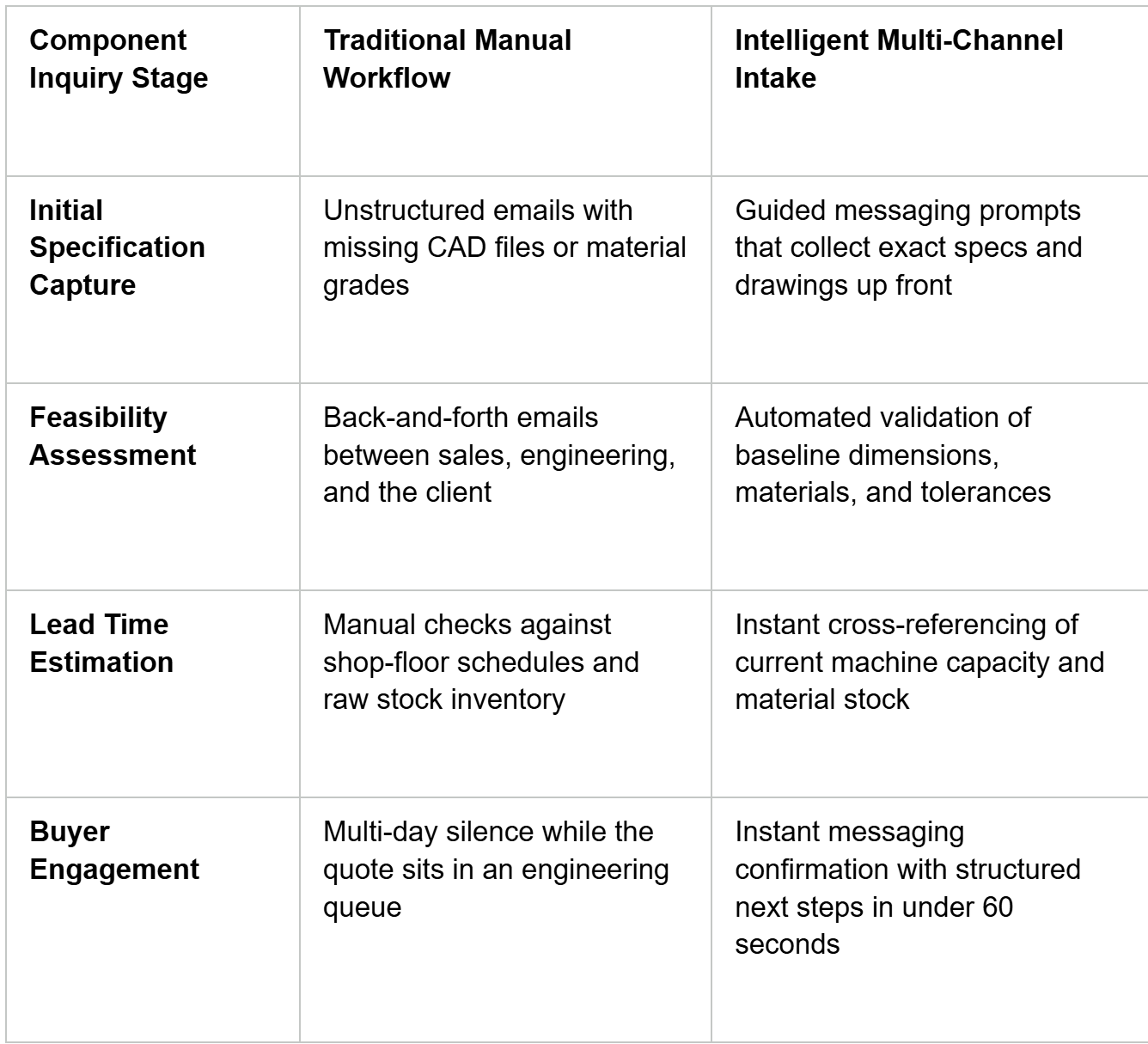
If your sales desk cannot confirm whether your facility can meet basic material, tolerance, and turnaround requirements within minutes of an inquiry, you risk forfeiting lucrative component production runs.
Streamlining technical component discovery requires meeting industrial buyers where they operate, whether at an office desk or on the shop floor using mobile messaging. Deploying a structured conversational intake layer across SMS, WhatsApp, and web portals allows independent manufacturers to gather critical technical parameters immediately without burdening senior engineering staff.
[ Buyer Inquires via SMS / WhatsApp / Web ]
│
▼
┌───────────────────────────────────────────────────┐
│ Guided Technical Intake Layer │
│ 1. Collects Material Specs (e.g., 316L, 4140) │
│ 2. Prompts for CAD / Drawing File Uploads │
│ 3. Captures Required Quantities & Tolerances │
└───────────────────────────────────────────────────┘
│
▼
┌───────────────────────────────────────────────────┐
│ Automated Pre-Qualification & Capacity Check │
└───────────────────────────────────────────────────┘
│
┌───────────┴───────────┐
▼ ▼
( Feasible Match ) ( Complex / Custom )
│ │
▼ ▼
Direct Routing to Fast-Track Handoff
Estimating Desk to Senior Engineer
When a buyer submits an urgent inquiry, the automated messaging channel guides them through a fast, structured intake sequence:
Automating the initial intake phase transforms how independent machinery manufacturers compete against larger corporate rivals. By instantly collecting complete engineering requirements and verifying baseline manufacturing fit, your team eliminates days of unnecessary back-and-forth communication.
Engaging buyers the moment intent is highest prevents drop-off, shortens sales cycles, and keeps your machining centers running at peak capacity.
Ready to capture urgent component inquiries and eliminate engineering backlogs? You can explore a live view of our private platform through our online scheduling system or reach out directly to our technical integration team at hello@salesape.ai to discuss your manufacturing intake workflows.
Modern multi-channel messaging platforms allow buyers to upload STEP, IGES, DWG, and PDF files directly through WhatsApp, web chat, or SMS links, automatically attaching them to the job file for estimator review.
Yes. Custom triage rules can automatically screen for minimum order quantities, unsupported material types, or extreme tolerance requirements, ensuring your engineering team only spends time on viable, high-margin opportunities.
Absolutely. The automated layer does not replace your engineers; it collects all necessary specifications, drawings, and context up front so your engineers can perform feasibility reviews in minutes rather than spending days chasing down missing information.