.svg)
Discover ideal response times for different industries – from e-commerce to healthcare. Learn why "fast enough" varies and how to gain a competitive edge by optimizing your speed to lead.
In this series, we’re covering the topics Dom (Head of Sales at SalesApe) and Frank (CEO of Salesforge) discussed in our webinar, How To Use AI To Make Sure You Never Miss An Inbound Lead Again. You can watch the whole video here but each week, we’re going to be covering a different topic from the webinar and recapping the salient points.
You can check out article one (the intro) here and article two (The Importance of Speed to Lead) here.
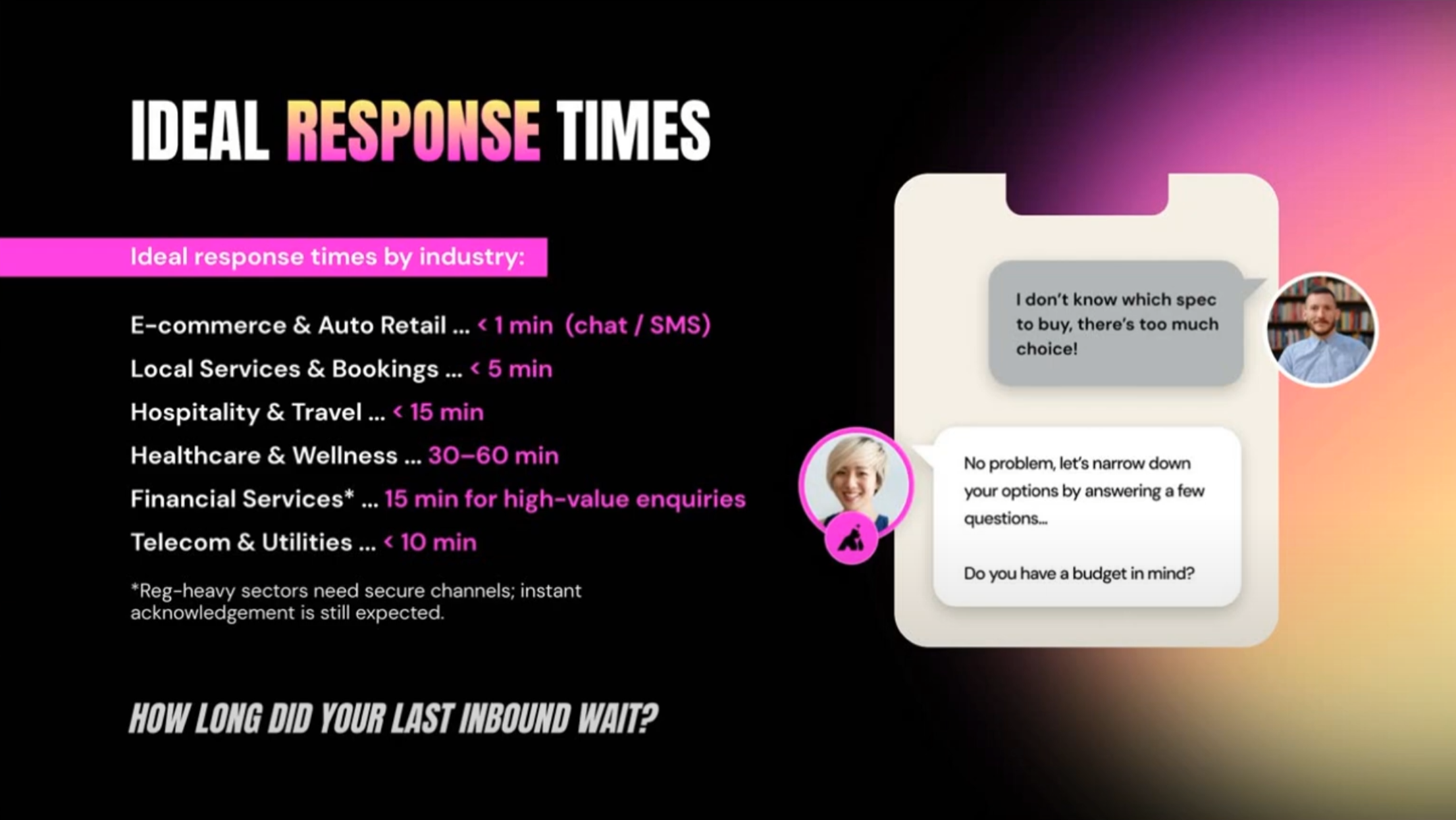
In our last article, We established that speed to lead is a game-changer for your business. But here's the next question: how fast is fast enough for your specific industry? The answer isn't "as fast as possible." It’s a bit more nuanced than that.
The truth is, what's a blazing-fast response in one sector might be considered slow in another. A car dealership is a world away from a healthcare provider. So, let’s break down the optimal response times for different industries.
For industries like e-commerce and retail, the expectation is immediate. We're talking less than a minute. Think about it: a shopper on your website has a question right now, and if they have to wait, they'll just go to a competitor. New technologies make it possible to have a virtual salesperson available 24/7 to handle these inquiries.
In other sectors, like SaaS and technology, the expectation is a bit more forgiving, but not by much. While it's a long, complex sales cycle that could last for months, having that first conversation in under 15-30 minutes is critical. It shows your business is on top of things and ready to help, setting the stage for a positive relationship.
Even in more complex sectors like healthcare or finance, where inquiries can be intricate and subject to compliance, an instant acknowledgement is an absolute must. While the full response might take longer, an AI agent can provide that immediate touch, making sure the lead knows they've been heard and that you'll get back to them.
It's common for sales leaders to know that speed is important, but a lot of them aren’t actively tracking it. As Frank pointed out in our webinar, many leaders are shocked when they learn how long their leads are actually waiting.
Here's an exercise you can do right now: go to a competitor’s website and try their chat support. See how long it takes for them to respond. If it takes them hours or even a full day, that should tell you everything you need to know. You've just identified a huge competitive advantage you can seize.
In a "red ocean" market with a ton of competitors, being the fastest one to the finish line can be the difference between winning and losing. Next, we'll dive deeper into the hidden bottlenecks that are holding your business back and how to fix them.
Customer expectations are shaped by the nature of the purchase. In e-commerce or retail, the impulse to buy is immediate, requiring a response in less than a minute to prevent a lead from bouncing to a competitor. In contrast, SaaS or technology sectors often have longer sales cycles where a 15 to 30 minute response is acceptable, as it signals professionalism and readiness to handle complex technical needs.
In highly regulated sectors like finance or healthcare, providing a full answer immediately may be impossible due to compliance and the complexity of the inquiry. An instant acknowledgment is an automated but personalized touch from an AI agent that confirms the lead has been heard. This simple interaction prevents lead decay and reassures the prospect that their sensitive inquiry is being processed by a professional team.
The Red Ocean Test involves secret shopping your direct competitors to see how long they take to respond to a simple chat or web inquiry. In crowded markets, most companies still suffer from human-centric delays, often taking hours or days to reply. If you can use AI to consistently hit sub-60-second response times while your competitors lag, you have identified a primary reason why customers will choose your business over theirs.
While speed is generally a major advantage, the goal is to meet or slightly exceed the specific expectations of your target audience. For a car dealership, speed to lead is a make-or-break metric because the buyer is often actively shopping multiple lots. For a specialized consultant, the quality and depth of the initial response are just as important as the speed, though an initial instant touchpoint still remains the best practice to secure the lead.
Yes. Modern AI agents are trained on industry-specific datasets and individual company brand guides. This allows them to adapt their tone and depth of information based on the sector. An AI agent for a retail brand will be punchy and sales-focused, while an agent for a professional services firm will be programmed to provide a more formal, structured acknowledgment that aligns with the expectations of that client base.