.svg)
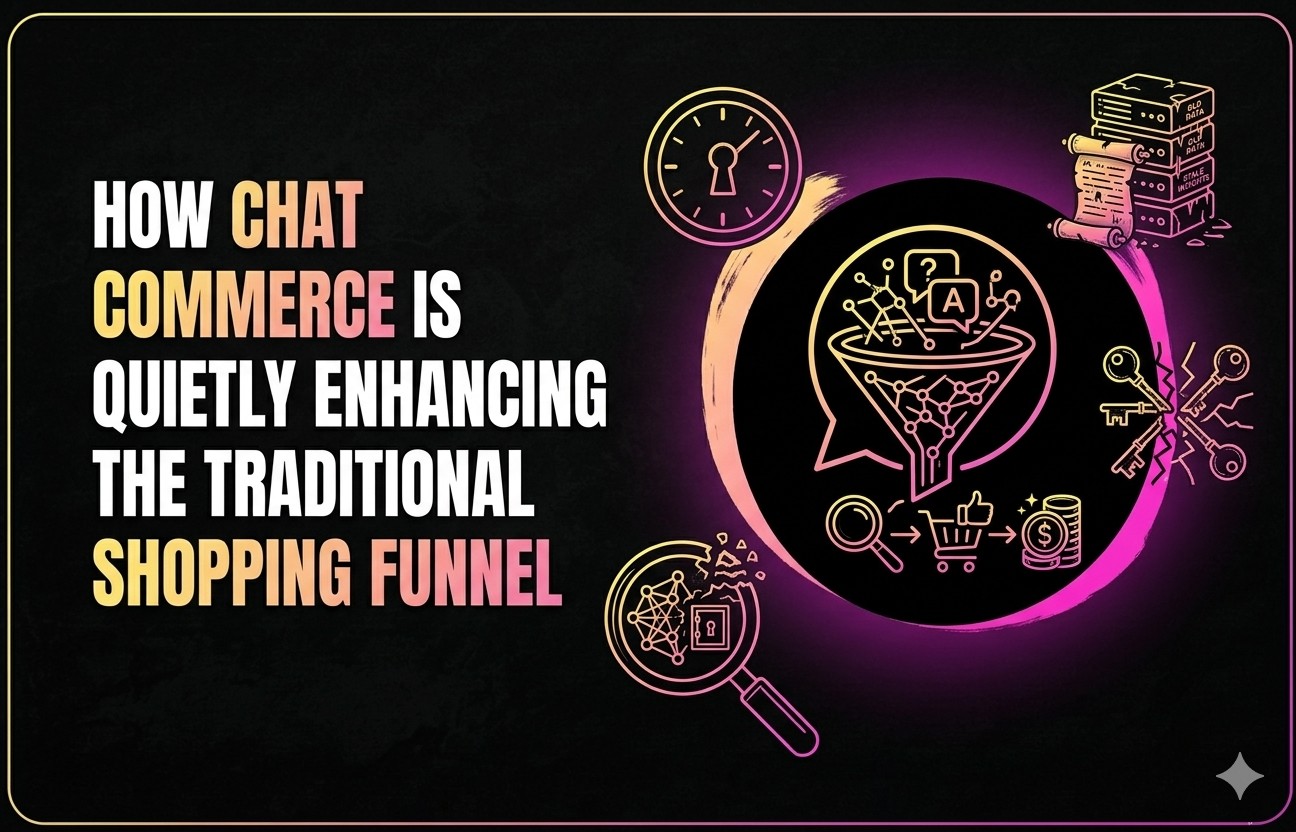
Discover how chat commerce is revolutionizing the shopping funnel by replacing complex, multi-tab journeys with seamless, personalized conversations that boost conversion.
TL;DR
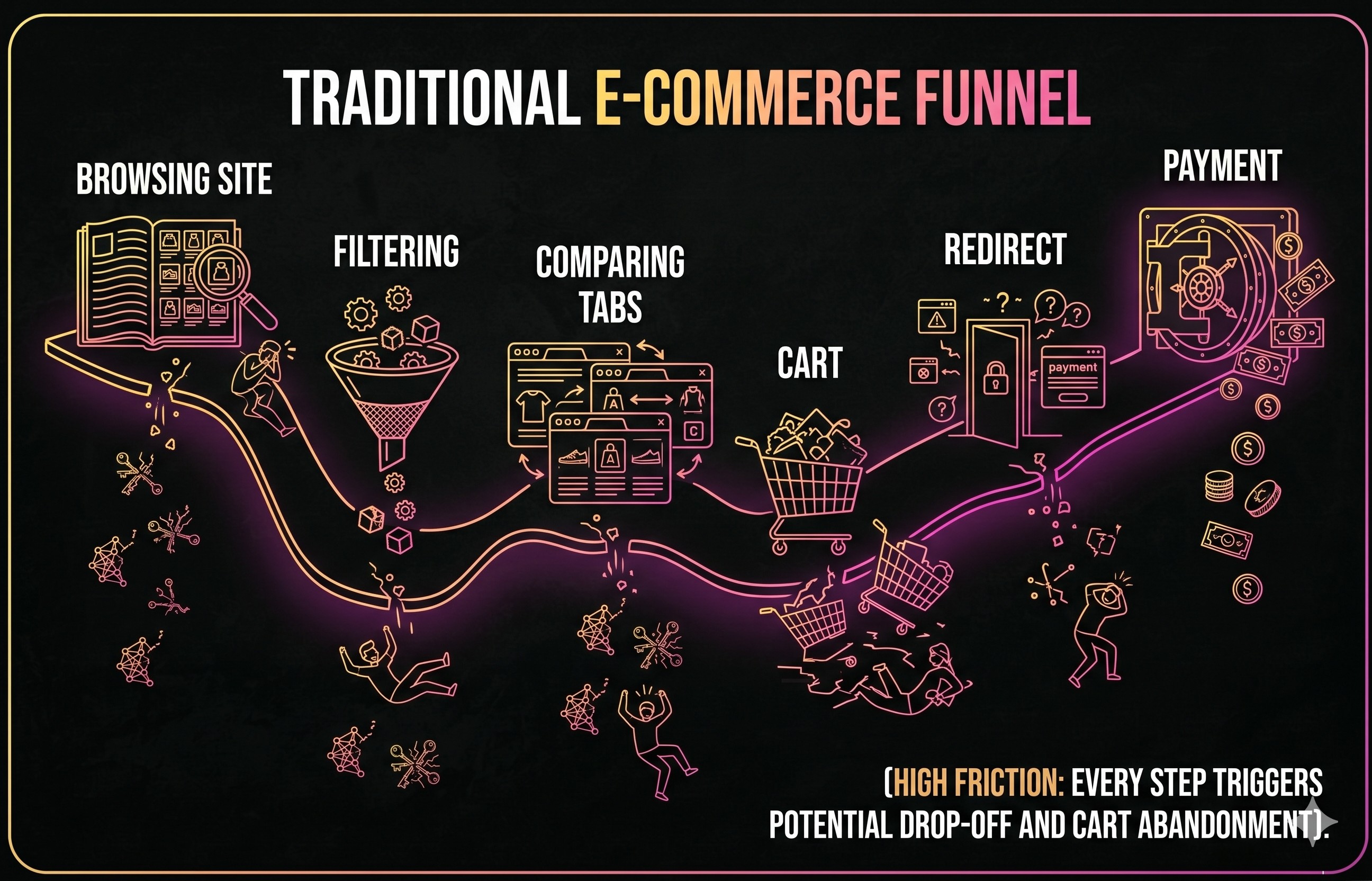
Think about the standard routine of buying something complex online today. Let’s say you are trying to book a family vacation, find the right running shoes for a specific foot type, or buy a piece of enterprise software for your team. The process immediately fractures into an exhausting multi-tab marathon.
You open one tab to search for options, three more tabs to look up reviews, another tab to check sizing guides, and a final tab to compare prices. You are constantly bouncing back and forth, copying and pasting specifications, and wrestling with clumsy sidebar filters that never seem to show you exactly what you need. By the time you finally click "Add to Cart," you haven't enjoyed a premium shopping experience—you’ve completed a data entry project.
But beneath the surface of the retail world, a massive behavioral shift is permanently retiring this fragmented journey. The traditional online sales funnel—the multi-step path requiring users to click through pages, browse directories, and fill out forms—is completely collapsing.
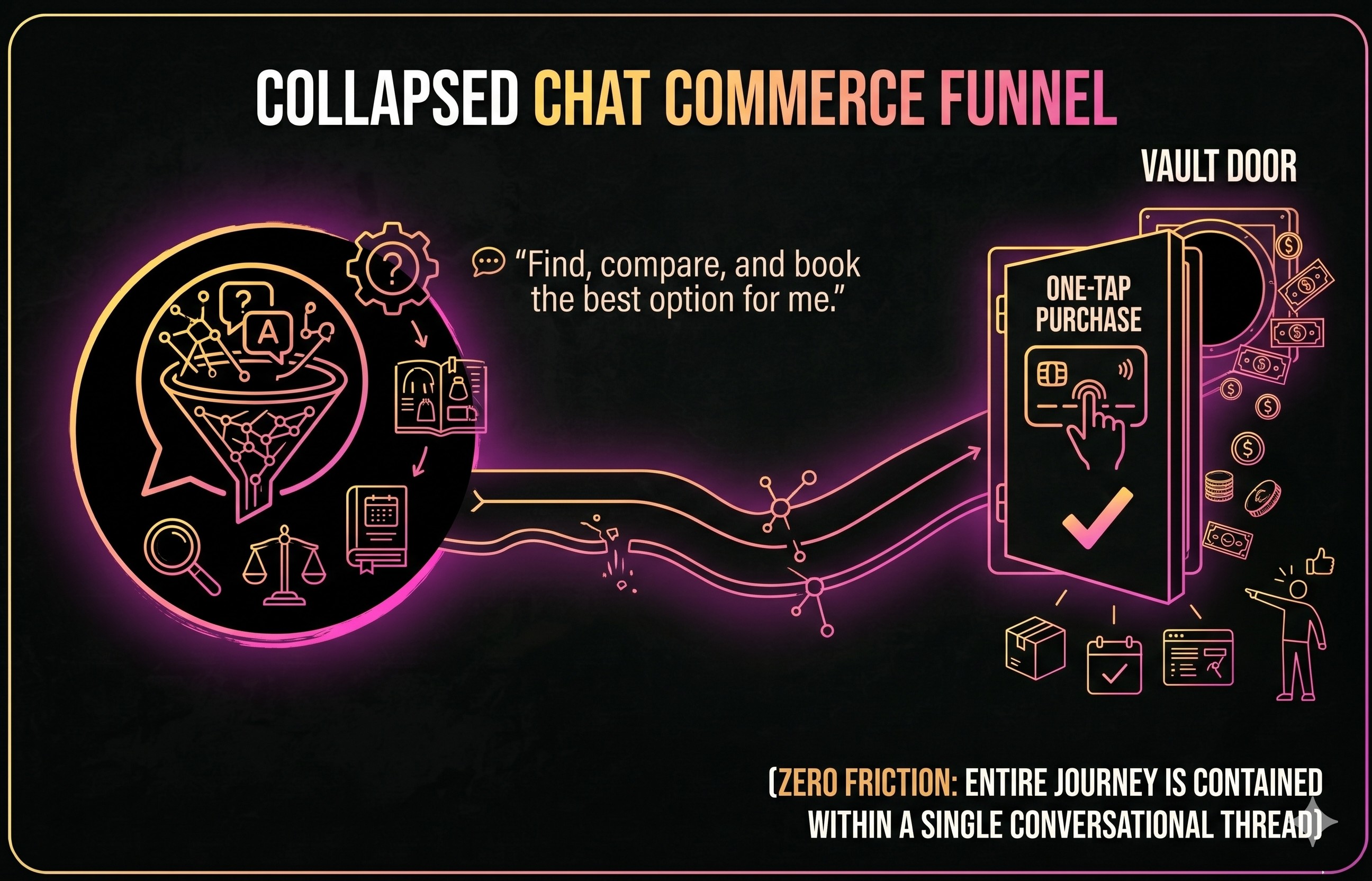
Instead, the modern consumer is turning to a single, continuous, and deeply personalized conversation. Welcome to the era of chat commerce, where the distance between an initial question and a completed purchase has shrunk to a single message bubble.
For nearly two decades, e-commerce was built on a simple premise: give the user an infinite catalog of options and let them filter their way to a decision. While this gave consumers unprecedented access to products, it ultimately created a state of analysis paralysis. Shoppers grew tired of scrolling through thousands of nearly identical listings.
The market metrics show that consumers are actively abandoning the endless scroll. Recent data from Adobe Analytics tracks an astronomical 4,700% year-over-year surge in AI-referred traffic to US retail sites. Buyers are no longer typing vague keywords into retail search bars and manually sifting through inventory.
Instead, they are leaning on intelligent conversational assistants to do the heavy lifting for them. The technology has evolved from a passive, text-matching search tool into an active personal shopper that can understand nuance, interpret complex constraints, and deliver an immediate, curated solution.
The secret to why chat commerce drives such staggering conversion rates comes down to a fundamental rule of human psychology: any time you force a user to switch apps, open a new link, or redirect to an external checkout page, you lose their momentum. Every extra click is an explicit invitation for the buyer to get distracted, change their mind, or abandon their cart entirely.
A comprehensive look at global retail patterns by Mordor Intelligence shows that integrating secure, instant payment systems directly into messaging applications slashes cart abandonment rates by thirty percent compared to traditional mobile-web checkout flows. Consumers are treating messaging apps—whether it is WhatsApp, RCS texting, or a dedicated website chat module—as a complete, self-contained ecosystem.
When a system can instantly answer a sizing question, confirm shipping timelines, pull up authentic user reviews, and process a secure, one-click payment right inside the live thread, the buying friction drops to zero.
VS
The massive mainstream explosion of chat commerce proves that modern consumers place a massive premium on the value of their own time and mental bandwidth. They no longer tolerate being forced to act as their own data analysts, navigating complex site maps or decoding rigid dropdown menus just to give a company their money.
This behavioral shift represents a critical milestone for system designers and revenue leaders across every industry. Once a consumer gets used to the sheer luxury of an intelligent system that listens to their needs, interprets their exact context, and completes their transaction within a single conversation, legacy web forms start to feel ancient.
The future of commerce belongs entirely to the brands that stop making their customers search, and start allowing them to simply talk.
While chat-based buying originally gained traction with quick, low-cost consumer goods, the infrastructure has rapidly scaled across high-consideration B2C and complex B2B sectors. Enterprise-grade networks are successfully processing transactions for everything from automotive fleet packages to enterprise software subscriptions within conversational threads. The key is that high-cost items typically require more conversation, deeper clarification, and real-time objection handling—making a fluid, data-backed chat interface the perfect environment to nurture a high-value buyer smoothly toward a close.
Modern chat commerce platforms completely isolate your personal payment data from the conversational text layer by utilizing secure, tokenized API integrations (such as Stripe, WhatsApp Pay, or Apple Pay). When you initiate a transaction, the chat engine surfaces an encrypted, compliance-secured payment module within the thread. Your credit card details are processed directly through tokenized banking networks rather than being read or stored by the underlying language model, ensuring total security that satisfies strict global financial compliance standards.
Rather than wiping out human roles, chat commerce functions as an incredible operational multiplier for your best talent. By allowing automated assistants to handle the repetitive, high-volume administrative tasks—such as fetching sizing availability, tracking tracking numbers, and processing standard checkouts—your human experts are freed from the digital noise. They can step into the conversation with full contextual history the exact second a high-value customer raises a highly complex question, a custom enterprise requirement, or a nuanced objection that requires true empathy and strategic thinking to resolve.