A Step-by-Step Framework for Mapping Your Own Lead Handover Process
Kim Taylor
•
August 16, 2026
•
3 mins
A practical, tool-agnostic framework for mapping the handover from automated screening to a live sales rep, with a one-page checklist to spot gaps.
TL;DR
Most handovers between automated screening and a live rep break at one of four predictable points: unclear qualification, unclear routing, missing context, or no rule for ambiguous cases.
This framework walks through each point as a concrete step, with specific questions to answer, not general advice to keep in mind.
Use the checklist at the end to audit whatever process you already have, even if it wasn't built using this framework.
This is a practical, tool-agnostic framework for mapping a lead handover process, from whatever screens or qualifies your inbound leads, to whoever picks them up. It works whether your qualification step is a person, a form, or an automated system. The goal is a specific map you can actually check your current process against, not a general description of best practice.
Why most handovers break at one of four predictable points
Before mapping your own process, it helps to know where handovers typically fail:
Unclear qualification — "good lead" means something different to different people on the team.
Unclear routing — a lead qualifies, but it's unclear who's supposed to act on it next.
Missing context — the lead reaches a person, but the reasoning behind why it qualified didn't travel with it.
No rule for ambiguous cases — a lead is a borderline case, and there's no defined fallback for what happens then.
Most handover problems trace back to one of these four gaps. The steps below map directly onto them.
Step 1: Define what "qualified" actually means
Write down the specific, checkable criteria a lead has to meet before it's considered qualified. Avoid vague standards like "seems interested" or "good fit." Use criteria that someone else on your team could apply consistently without asking you for clarification.
Questions to answer:
What specific information does a lead need to have provided? (e.g., budget range, timeline, decision-making authority)
Is there a minimum threshold, and what is it exactly?
Are there any automatic disqualifiers? (e.g., wrong region, wrong company size)
Who currently decides whether a borderline lead qualifies, and would they agree with someone else's call on the same lead?
Output of this step: A written list of qualification criteria specific enough that two different people would reach the same conclusion on the same lead.
Step 2: Decide exactly where a qualified lead goes
A lead qualifying is only useful if there's a specific, predetermined destination for it. "Whoever's free" or "the sales team" is not specific enough, it introduces delay while someone figures out ownership.
Questions to answer:
Does a qualified lead go to a named individual, a specific team queue, or directly into a booking flow?
If it's assigned by territory, product line, or account size, is that assignment rule written down somewhere, or does it live only in someone's head?
What happens if the intended recipient is unavailable? Is there a backup, or does the lead simply wait?
How quickly after qualification does the routing actually happen: instantly, within the hour, at the next check-in?
Output of this step: A named person, queue, or process for every category of qualified lead, with no category left as "figure it out later."
Step 3: Map exactly what context has to travel with the lead
Decide, specifically, what information should accompany a lead when it's handed off. "Everything" is not a useful answer, it usually means whoever receives the lead has to dig through a full history to find what matters.
A reasonable starting list to adapt:
What the lead asked about or was interested in
The specific criteria that made them qualify
Any concerns, objections, or hesitations already raised
Preferred contact method and any timing constraints they've mentioned
What's already been promised or communicated to them, if anything
Questions to answer:
Does this information currently get passed along automatically, or does the receiving person have to ask for it?
If it's automatic, where does it actually show up, in the CRM record, a message, a separate note?
Has anyone on the receiving end ever had to ask "wait, why did this qualify?" If so, this step isn't working yet.
Output of this step: A specific, short list of fields or details that travel with every handoff, and confirmation of exactly where they show up for the receiving person.
Step 4: Set the rule for what happens when qualification is ambiguous
This is the step most handover processes skip, and it's usually where things quietly break down. Real leads don't always cleanly qualify or disqualify. Decide in advance what happens with the ones in between.
Questions to answer:
What's the actual definition of "borderline" for your criteria? (e.g., meets 3 of 4 criteria, budget is close but unconfirmed)
Does a borderline lead get routed anyway with a flag, held for manual review, or something else?
Who's responsible for making that judgment call, and how quickly are they expected to make it?
Is there a maximum time a borderline lead can sit unresolved before it's escalated or defaulted somewhere?
Output of this step: A specific, written rule for the ambiguous middle ground, so it doesn't get decided fresh, inconsistently, every time it comes up.
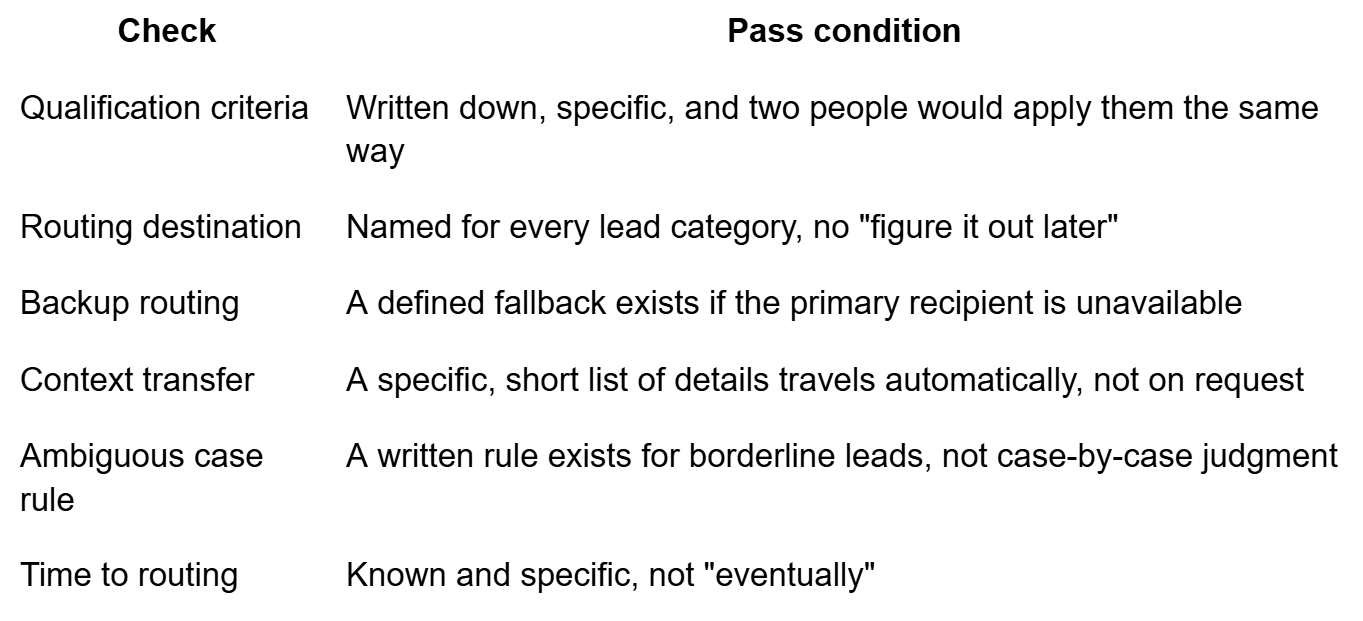
A one-page way to check your own map for gaps
Use this as a quick audit, even for a process that already exists.
If any row doesn't have a clear, specific answer, that's the actual gap in your current handover, not a hypothetical one.
See this mapped against a real process
If you want help mapping this against your specific workflow rather than working through it alone, that's a reasonable thing to ask for. Book a demo with SalesAPE to walk through it, or reach out at hello@salesape.ai if you'd like to talk it through first.
FAQs
What's the most common point where a lead handover process breaks down?
Missing context is one of the most common failure points, a lead reaches a rep without the specific reasoning for why it qualified, forcing the rep to start the conversation from scratch or ask the lead to repeat information they've already provided.
Do I need special software to map a lead handover process?
No. This framework is tool-agnostic and works whether your qualification step is a person, a form, or an automated system. What matters is having specific, written answers to each step, not a particular piece of software.
How specific should qualification criteria actually be?
Specific enough that two different people applying the same criteria to the same lead would reach the same conclusion. If your current criteria depend on someone's individual judgment or experience to interpret consistently, they're not specific enough yet.
What should happen with a lead that's borderline, not clearly qualified or disqualified?
There should be a predetermined rule, not a case-by-case decision. Whether that means routing it with a flag, holding it for manual review, or something else depends on your business, but the rule itself needs to be decided and written down in advance.
{
"@context": "https://schema.org",
"@type": "FAQPage",
"mainEntity": [
{
"@type": "Question",
"name": "What's the most common point where a lead handover process breaks down?",
"acceptedAnswer": {
"@type": "Answer",
"text": "Missing context is one of the most common failure points, a lead reaches a rep without the specific reasoning for why it qualified, forcing the rep to start the conversation from scratch or ask the lead to repeat information they've already provided."
}
},
{
"@type": "Question",
"name": "Do I need special software to map a lead handover process?",
"acceptedAnswer": {
"@type": "Answer",
"text": "No. This framework is tool-agnostic and works whether your qualification step is a person, a form, or an automated system. What matters is having specific, written answers to each step, not a particular piece of software."
}
},
{
"@type": "Question",
"name": "How specific should qualification criteria actually be?",
"acceptedAnswer": {
"@type": "Answer",
"text": "Specific enough that two different people applying the same criteria to the same lead would reach the same conclusion. If your current criteria depend on someone's individual judgment or experience to interpret consistently, they're not specific enough yet."
}
},
{
"@type": "Question",
"name": "What should happen with a lead that's borderline, not clearly qualified or disqualified?",
"acceptedAnswer": {
"@type": "Answer",
"text": "There should be a predetermined rule, not a case-by-case decision. Whether that means routing it with a flag, holding it for manual review, or something else depends on your business, but the rule itself needs to be decided and written down in advance."
}
}
]
}
.svg)